
Key Points
- George E. Johnson, founder of Johnson Products, died July 6 in Chicago at age 99.
- His Ultra Sheen and Afro Sheen brands made his firm the exclusive sponsor of "Soul Train."
- In 1971 Johnson Products became the first Black-owned company on the American Stock Exchange.
- He started the company in 1954 with a $250 loan he secured under a pretext.
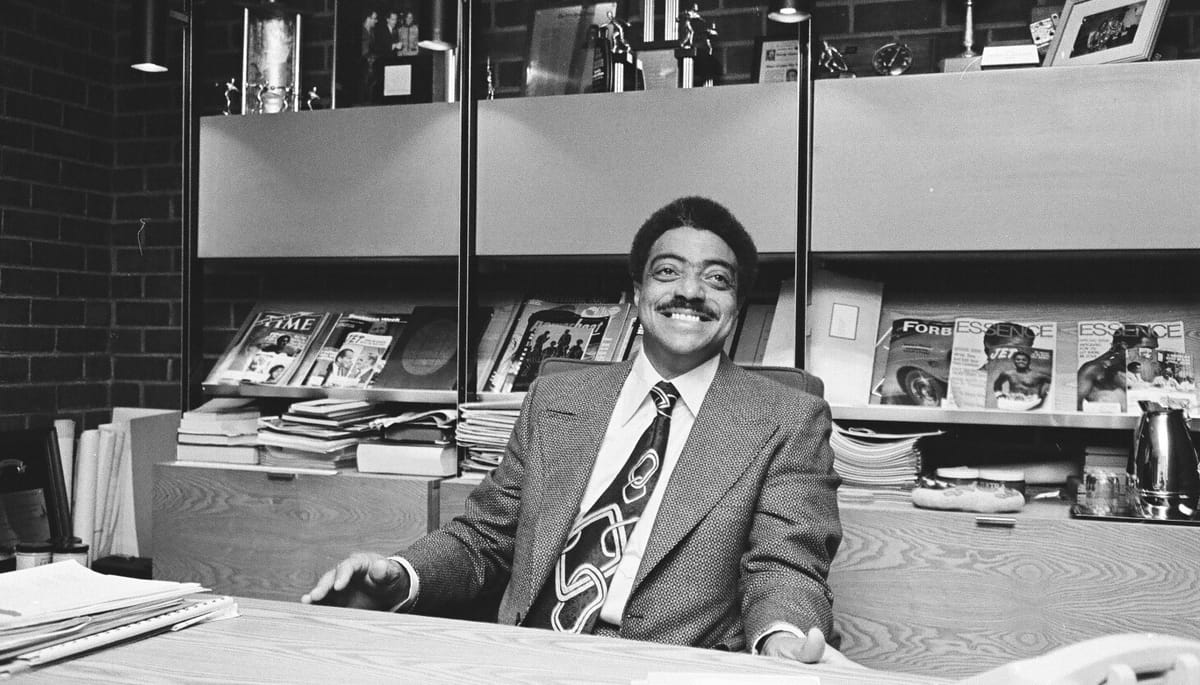
George E. Johnson, the Chicago entrepreneur who built Johnson Products into a Black hair-care empire and, in 1971, made it the first Black-owned company to trade on a major American stock exchange, died Monday, July 6, at his downtown Chicago condominium. He was 99, and died of natural causes.
Johnson's beginnings were the stuff of the story he liked to tell. Born in 1927 in a three-room sharecropper's shack in Richton, Mississippi, he moved to Chicago as a toddler and, by 1944, was working as a production chemist for the Black cosmetics magnate Samuel B. Fuller. When he set out on his own in 1954, a bank turned down his request for a $250 loan — so he came back and said he needed the money for a California vacation, and walked out with it. "I knew this request wouldn't rattle his belief that he was superior to me," Johnson later said.
That $250 became Ultra Wave, then Ultra Sheen, and — as the Afro became a statement in the late 1960s — Afro Sheen, along with Classy Curl, Curly Perm and Black Tie cologne. But Johnson's most lasting move was where he spent his marketing money. He became the exclusive sponsor of "Soul Train," and worked with the pioneering Black Chicago ad houses of Vince Cullers and Tom Burrell to put positive images of Black families and professionals on national television at a time when almost no one else would. A Black-owned company was advertising to Black consumers, in Black-owned media — control of the full chain, not just a slice of it.
The 1971 American Stock Exchange listing was the milestone that outlived the products: the first time a Black-owned company traded on a major U.S. exchange, a line later crossed by others but never again for the first time. Johnson turned the proceeds outward, giving millions through his foundation to put minority students through college — the same instinct behind today's Black-legacy philanthropy, from Young Guru's full-tuition Roc Nation School scholarship to Google and Idris Elba's fund opening AI-tool access to African creators.
The company itself did not stay his. Johnson Products was sold to Miami's Ivax Corp. in 1993, passed later to Procter & Gamble, and was bought back by a multiracial investor group in 2009; the old South Side headquarters now houses a charter school. But the through-line is the point of the life: decades before "ownership" became a rallying word in Black culture and business, Johnson had already built the model — a Black founder who owned the manufacturing, the marketing, and a seat on Wall Street at once. He is survived by his wife, Madeline Murphy Rabb; sons John Edward, Eric George, and George "Petey" Ellis Jr.; daughter Joan Marie; and several grandchildren.
Source: Chicago Sun-Times, CBS Chicago.
Comments