
Yesterday we published a breakdown of the Citrini Research scenario that rattled markets last week — a thought exercise projecting what happens to the white-collar economy if AI-driven displacement accelerates faster than institutions can adapt. One of the positions we outlined in the Uristocrat playbook was to own the infrastructure rather than just the output. A few readers asked the obvious follow-up: okay, but how?
This is that answer.
The framing matters before we get into specifics. The infrastructure bet isn't "AI is going to be big." The market already knows that. Every major index is pricing in significant AI optimism. The more durable thesis — and the one that holds in both the optimistic and pessimistic scenarios the Citrini paper lays out — is that the buildout cycle is longer, more capital-intensive, and more broadly distributed across the supply chain than current valuations fully reflect. The companies supplying the picks and shovels tend to retain pricing power across the full cycle in ways that application-layer bets don't. You're not predicting which AI product wins. You're betting that the physical and electrical infrastructure powering all of them keeps getting built.
There are four layers to that infrastructure stack, and each one has a different risk profile, accessibility level, and upside ceiling.
Layer One: Semiconductors
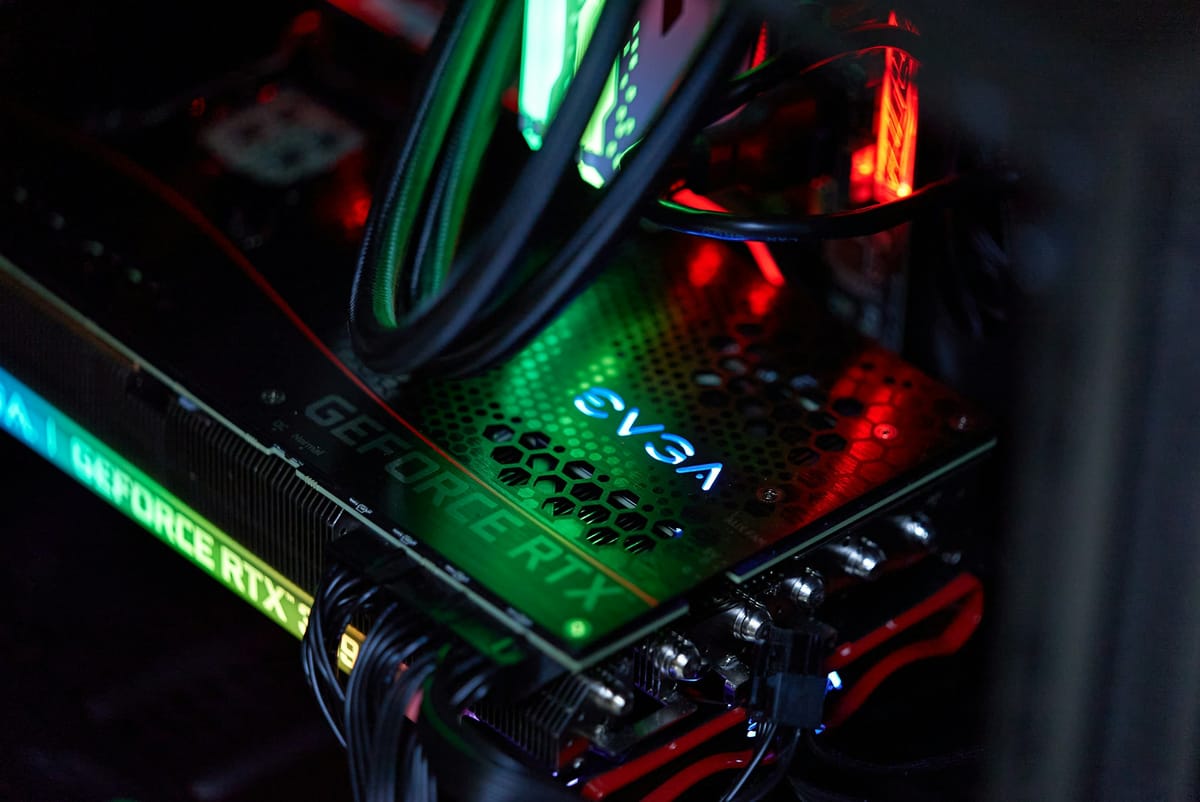
This is where most people start, and for good reason. Chips are the irreducible input to everything else — you cannot run an AI model without them. NVIDIA has become the defining trade of the current cycle because its H100 and Blackwell GPUs are the standard hardware for training and running frontier AI models. The company's revenue growth over the last two years has been extraordinary even by historical tech standards, and its gross margins suggest genuine pricing power rather than commodity dynamics.
But NVIDIA is not the only name worth knowing. AMD is the credible alternative GPU provider and has been gaining ground in the data center market. Broadcom designs the custom AI accelerator chips that hyperscalers like Google and Meta use to reduce their dependence on NVIDIA — a massive and growing market. And TSMC, the Taiwan Semiconductor Manufacturing Company, manufactures the actual silicon for essentially every major chip designer in the world. If NVIDIA designs the engine, TSMC builds it. That's a structural position that's difficult to replicate and nearly impossible to route around.
For someone who wants semiconductor exposure without the concentration risk of a single name, SMH (VanEck Semiconductor ETF) and SOXX (iShares Semiconductor ETF) are the standard vehicles. Both are NVIDIA-weighted but diversified across the supply chain — fab equipment companies like ASML and Applied Materials, memory manufacturers, and downstream logic chip designers all have representation. Semiconductor ETFs are volatile, they move hard in both directions, but they give you the full cycle exposure in a single position.
Layer Two: Data Centers
This is the infrastructure layer that gets less attention than semiconductors but may be more interesting for Uristocrats who think in terms of durable real assets rather than growth multiples. Data centers are the physical buildings that house the servers, cooling systems, and networking equipment that AI runs on. They require enormous capital to build, years to permit and construct, and represent a genuinely scarce asset class — you can't spin up a hyperscale data center in a weekend the way a software startup can spin up a SaaS product.
Equinix (EQIX) and Digital Realty (DLR) are the two largest publicly traded data center REITs. Because they're structured as real estate investment trusts, they're required to distribute a significant portion of income as dividends, which makes them behave more like yield instruments than pure growth stocks. They benefit directly from hyperscaler capex expansion — every dollar Microsoft or Amazon spends on data center buildout either fills their existing facilities or creates demand for new capacity — without carrying the volatility profile of semiconductor names. Less upside ceiling, more predictable compounding.
The demand picture here is structurally favorable in a way that's hard to oversell. The Citrini paper noted that hyperscalers were spending $150-200 billion per quarter in aggregate on data center capex. That number has been going up, not down, through every quarterly earnings cycle this year. The physical supply of data center capacity has not kept pace. Vacancy rates in major markets — Northern Virginia, Silicon Valley, the Chicago suburbs — are at historic lows. New capacity takes 18-36 months to come online from the moment a site is selected. The supply-demand imbalance is not a prediction. It's the current reality.
Layer Three: Energy
This is the layer most people miss entirely, and it may be the most important one for the decade ahead. AI data centers are extraordinarily power-hungry. A single hyperscale data center campus can consume as much electricity as a small city. Training a large frontier model can consume more energy than a commercial aircraft uses crossing the Atlantic hundreds of times. And the buildout is accelerating.
The utility and power generation sector is experiencing something it hasn't seen in decades: genuine demand growth. For most of the last twenty years, electricity demand in the United States was essentially flat — efficiency gains from LED lighting, better appliances, and industrial optimization offset population and economic growth. AI has broken that trend. The grid is going to need significant new generation capacity, and it needs it fast.
GE Vernova (GEV) is the most cited name in this conversation — the Citrini paper specifically noted that its turbine capacity is sold out until 2040, which is either alarming or extremely bullish depending on which side of the trade you're on. Vistra (VST) and Constellation Energy (CEG) have both gotten significant attention as the AI power trade gained institutional recognition. Constellation is particularly interesting because of its nuclear focus — nuclear is the only carbon-free baseload power source that can scale fast enough to meet data center demand without intermittency issues, and it has received serious commitments from Microsoft and others specifically to power AI infrastructure.
The energy play is a slower-moving thesis than semiconductors. Power plants take years to permit, finance, and build. But that's the point — it's a long-duration structural story with real asset backing, and it's one where the demand signal is visible today in the forward order books of every major equipment manufacturer.
Layer Four: The Hyperscalers Themselves
Microsoft, Amazon, Google, and Meta are not pure infrastructure plays. They're consumer businesses, enterprise software companies, and advertising platforms. But their data center capex commitments mean that a significant and growing portion of their enterprise value is infrastructure. Owning them is a way to get exposure to the buildout while also holding diversified businesses that aren't entirely dependent on AI succeeding on any particular timeline.
QQQ (Invesco Nasdaq-100 ETF) is the broadest and most accessible vehicle for this exposure. It's not an infrastructure ETF — it holds consumer names, biotech, and industrial companies alongside the hyperscalers — but it gives you meaningful weight in the companies doing the most aggressive AI capital deployment without requiring you to pick between Microsoft and Amazon as individual positions.
For someone who wants broader AI exposure beyond the Nasdaq-100, BOTZ and AIQ exist as thematic ETFs, though both have their limitations. They tend to include companies that are AI-adjacent rather than AI-central, which dilutes the thesis. They're not wrong, but they require more scrutiny of the underlying holdings than SMH or SOXX does.
How to Think About Sizing
The infrastructure thesis is a long-duration bet, not a trade. The appropriate vehicle for most Uristocrats isn't picking individual names and monitoring them quarterly — it's systematic, recurring investment into the ETFs that cover the supply chain, held over years, allowing the compounding and the buildout cycle to do the work together. Dollar-cost averaging into SMH or EQIX on a monthly schedule — the same way you'd add to a broad index fund — captures the structural exposure without requiring you to time entries around earnings volatility.
The honest caveat is that these positions are already pricing in meaningful AI optimism. You are not getting in early in the way someone who bought NVDA in 2022 was getting in early. What you are getting is exposure to a buildout cycle that the physical and electrical constraints of the real world suggest has years left to run, at valuations that are elevated but not obviously disconnected from the forward demand picture.
That's a different risk profile than buying a speculative AI application company at 40x revenue. It's not risk-free. But the thesis doesn't require you to predict which AI product wins the market. It only requires that the infrastructure underneath all of them keeps getting built.
Given what every major technology company is spending right now, that seems like a reasonable bet.
Uristocrat does not provide financial advice. This article is for informational and analytical purposes only. Consult a qualified financial professional before making investment decisions.



Comments