
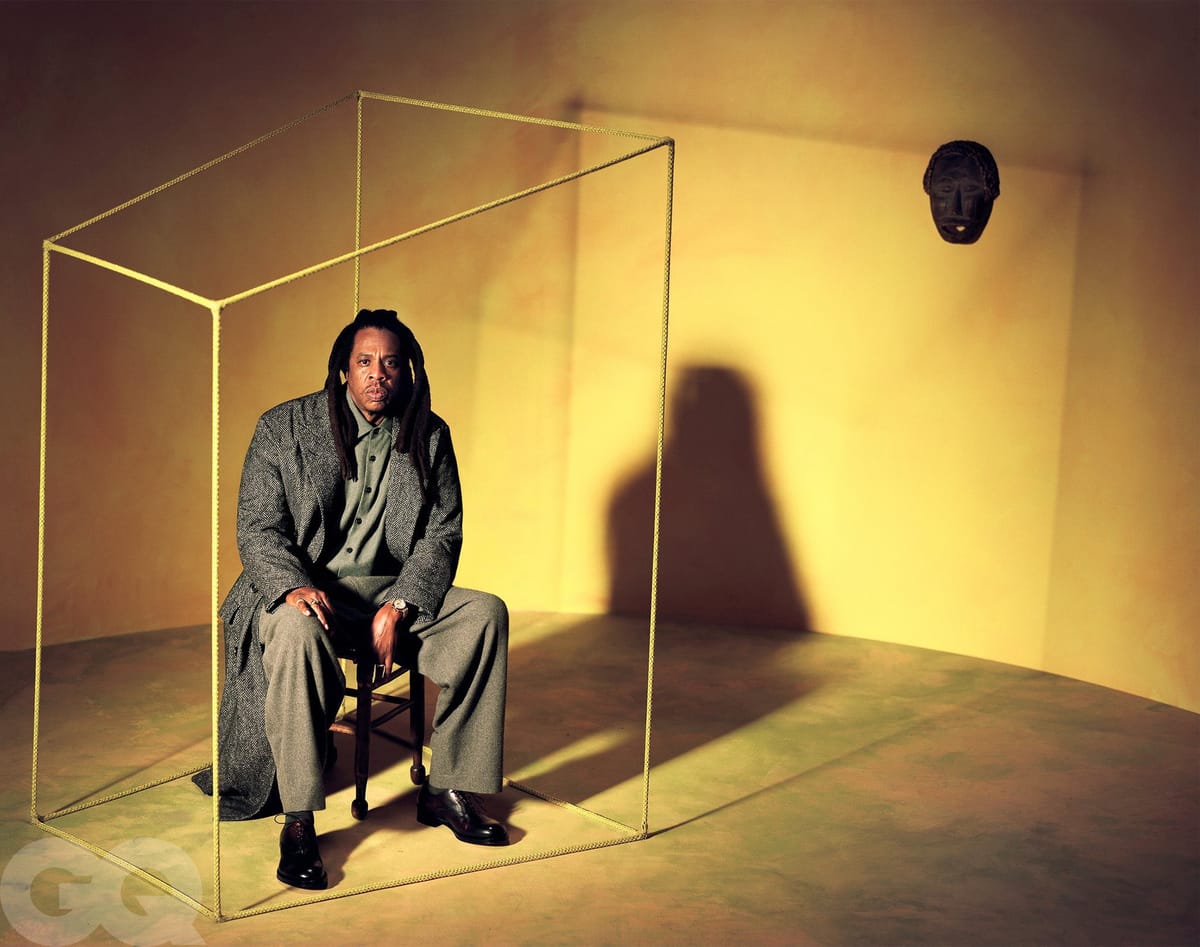
JAŸ-Z is back — and he wants you to know this one is different. The Brooklyn mogul covers GQ's April 2026 global issue, photographed by contemporary art star Rashid Johnson, in what is shaping up to be the most coordinated rollout of his career. The umlaut is back. The catalog just hit streaming for the first time. Vinyl reissues of classic records are in stores. Yankee Stadium dates are booked to celebrate the anniversaries of Reasonable Doubt and The Blueprint. And now a rare sit-down, two two-hour sessions with GQ editor Frazier Tharpe, followed by email and text exchanges — that gives the clearest window into where Hov's head is at heading into year 30.
The line everyone is running with: "We played enough defense. 2026 is all offense." He didn't confirm a new album, but he described what one would need to be. It can't be calculated. It can't be made for approval. "Trying to create something that people like is where I think a lot of artists get jammed up," he said. Whatever comes next has to be honest about where he is right now — or nothing comes at all.
On the Kendrick versus Drake moment, Jay offered the response you probably didn't expect. He framed it through hip-hop's four pillars — breakdancing, graffiti, DJing, and battling — and argued that each has drifted from the culture's center over time. The battle was real, and the music was exciting, but the collateral damage, the social media destruction of personal lives, the refusal to let things settle, made him conflicted about the whole thing. "You almost wish it didn't happen," he said. That's a complicated position from someone who built his early reputation on exactly that format, and he knows it.
He addressed the capitalist critique directly, a conversation that's followed him since his wealth became the story. His answer was essentially: the critique misunderstands the goal. Roc Nation's Super Bowl run — and the criticism that came with it for booking Kendrick, Rihanna, and Usain Bolt rather than underground acts — got the same treatment. "I didn't pick the indie artist I really like from Portland," he said. "These are the most famous people in the world. The number one streamed artist in the world." The argument isn't that smaller artists don't matter. It's that the Super Bowl stage was an opportunity to rebalance what popular music looks like, and that required names with the scale to actually move the needle.
The GQ cover itself is worth noting as an object. Rashid Johnson — whose work interrogates Black male identity, ambition, and interiority — is an intentional choice for a subject like this. Johnson connected Jay to a lineage of Black intellectual tradition: Harold Cruse, W.E.B. Du Bois, and Michael Eric Dyson. For a man whose critics have long tried to reduce him to a transaction, that framing is part of the message.
Whether there's an album at the end of this rollout or not, the campaign is already making the argument Jay wants to make: that at 56, with 30 years of documented cultural impact behind him, he's still setting the terms. The full story is in GQ's April issue, on newsstands March 31.
Comments