
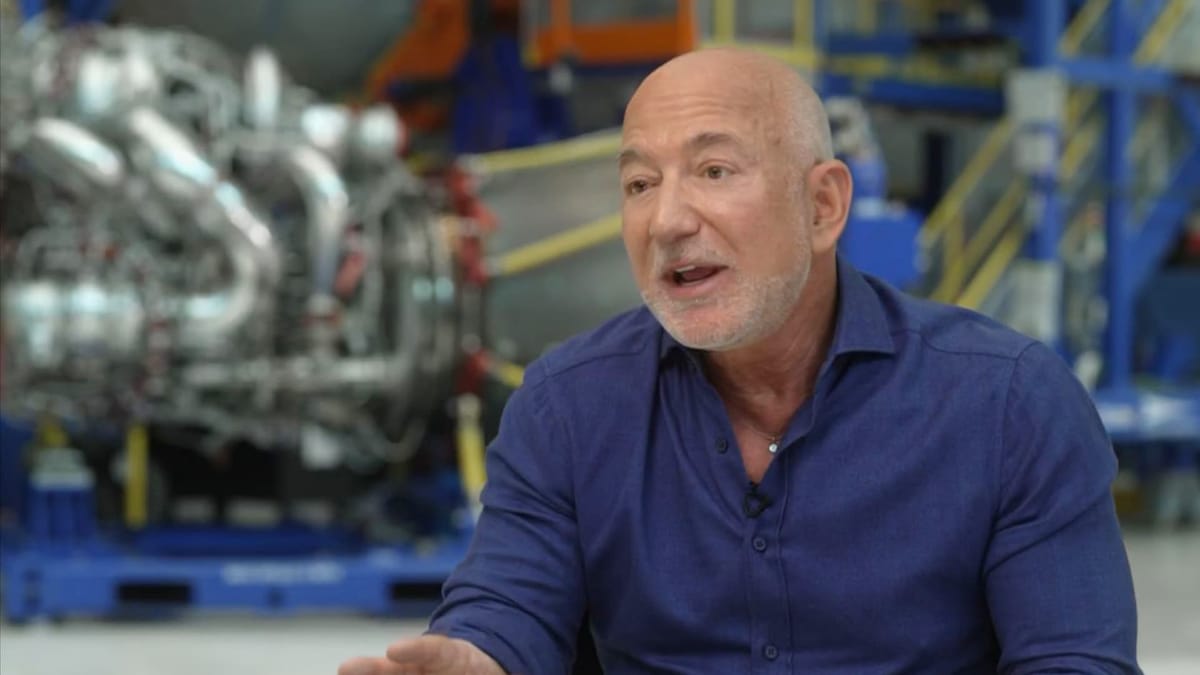
Speaking from Blue Origin's Florida facility on CNBC's Squawk Box on Wednesday, Jeff Bezos made a specific tax-policy argument: the bottom half of U.S. earners, who collectively pay roughly 3% of all federal income tax, should pay zero. "It should be zero," he said. He framed the case around a nurse in Queens making $75,000 a year and paying more than $1,000 a month in federal income tax — "a small amount of money for the government" that represents real hardship for working families.
The numbers Bezos is referencing
The 3% figure tracks federal data. The bottom 50% of U.S. earners pay about 3% of total federal income tax collected. The top 1% pay roughly 38% of federal income tax while reporting about 21% of adjusted gross income. The distribution is already heavily skewed toward the top — Bezos' point is that the bottom contribution is small enough in aggregate that eliminating it would barely move federal revenue while meaningfully changing household economics for tens of millions of people.
That arithmetic is not new. What is unusual is who is making the case, and from where. Bezos giving a tax-cut pitch on national television, hours after Blue Origin's most public week of operations in months, is its own kind of message.
The Bezos repositioning
Bezos has spent the past year reshaping his public profile away from Amazon — a $100 billion fund for AI-driven manufacturing acquisitions, the $10 billion Project Prometheus raise, and a steady drumbeat of policy commentary. Today's tax framing fits into a broader argument he has been building in public: that the U.S. economy works best when the bottom of the income distribution has more disposable income and the productive engine at the top is left to compound. Whether that argument lands as populism, libertarianism, or self-interested billionaire-class messaging depends entirely on who you ask.
The framing is also strategically useful. Bezos is in the middle of moving Blue Origin from launch cadence to actual revenue contribution, building out Project Prometheus, and positioning himself as a serious post-Amazon industrial player. Being known as the billionaire who argued for cutting taxes on nurses is a better profile than being known as the billionaire who avoided his own taxes in the ProPublica leaks — and he is openly working both sides of that ledger.
The policy question
Bezos' specific proposal — zero federal income tax for the bottom 50% — is closer to the existing structure than the framing implies. The bottom 40% of U.S. households already have a negative effective federal income tax rate after refundable credits like the EITC and CTC. The policy gap he is actually pointing at is between $50K and roughly $100K, where the effective rate jumps and a meaningful chunk of marginal labor income disappears to federal withholding. Eliminating that tier is a real policy proposal with a real cost — roughly $200 billion in annual revenue, by most credible estimates — and a real political constituency that has not yet been organized around it.
Whether that constituency gets organized is now a slightly different question than it was Tuesday. Bezos pitching the idea on CNBC moves it from think-tank white paper to mainstream tax debate in the span of one cable appearance. That is the leverage he was demonstrating today, more than the specific proposal itself.


Comments