
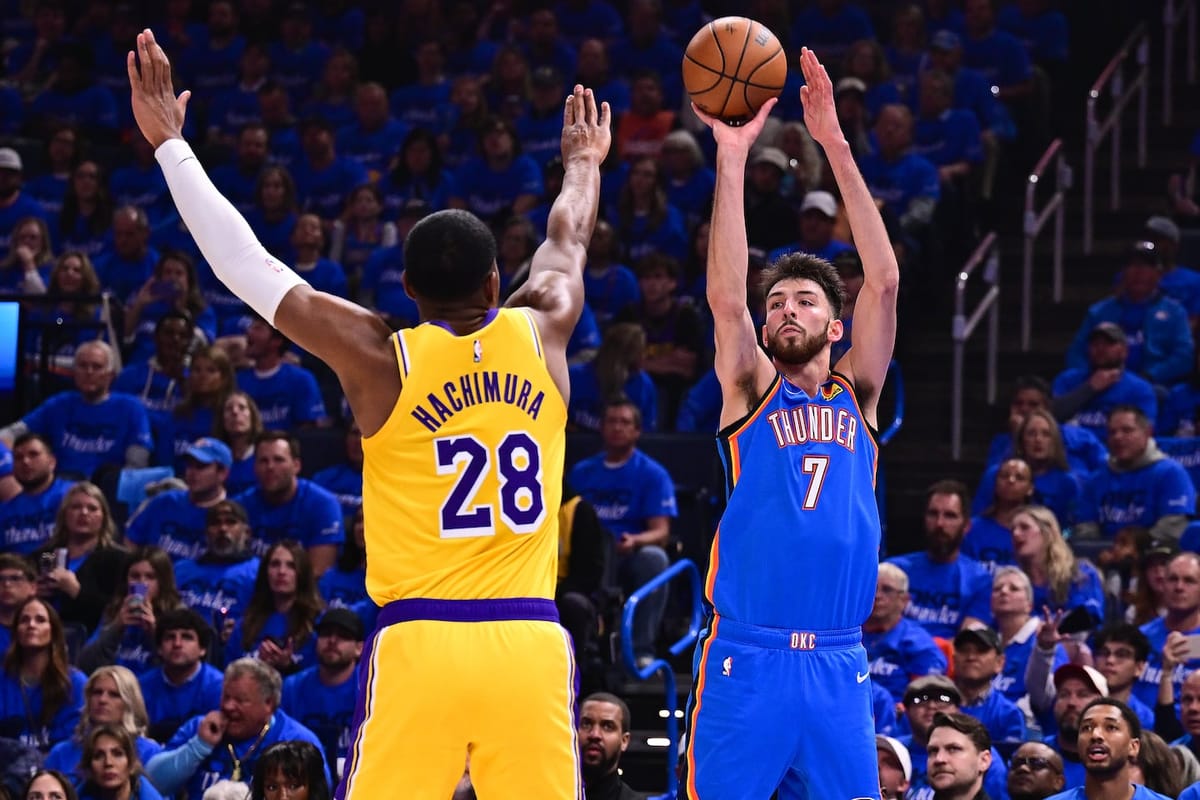
The Oklahoma City Thunder beat the Los Angeles Lakers 108-90 in Game 1 of the Western Conference semifinals on Monday night at Paycom Center. The headline number is Chet Holmgren's stat line — 24 points, 12 rebounds, 3 blocks, 9-of-17 from the field, 2-of-2 from three, 4-of-4 at the line, six dunks. The number underneath the headline is the one that matters more: 5-0. That's the Thunder's playoff record, and they got there without Jalen Williams.
What happened
OKC shot 49.4% from the field and made 13 of 30 from three. Holmgren's two-handed alley-oop in the second quarter put the Thunder up 48-39 and effectively ended the game's competitive phase. From that point on, this was a possession-quality matchup the Lakers couldn't win — too few healthy ball-handlers, too many late-clock isolations, not enough rim pressure.
LeBron James scored 27. He's the only Laker who looked like a problem all night, and even then his shot diet was the diet of a star carrying too much: contested jumpers, halfcourt sets that ran out the shot clock, drives into walls of rotating help. Without Luka Doncic — out a month with a hamstring — there is no second creation engine on the floor for Los Angeles. The Thunder defense knew it and engineered everything to that fact.
Why the Williams absence is the read
Jalen Williams is OKC's third-best player and arguably their second-best perimeter defender. He didn't play. The Thunder won by 18 anyway. They got six dunks from Holmgren and 30 three-point attempts from the rest of the rotation. Isaiah Hartenstein, Lu Dort, Aaron Wiggins, Jaylin Williams — the names rotate game to game, but the offense doesn't slip.
This is the structural reason the Thunder are the favorites in this series and most of the conversations beyond it. Their offense isn't built around any single player's individual creation. They have Shai Gilgeous-Alexander as the on-ball anchor, Holmgren as the gravity center inside, and a deep bench that can play 28-minute stretches without losing geometry. Every time they win without one of their stars, the league learns something new about how durable the system is.
What this says about the Lakers
The Luka trade was always a two-timeline bet. The first timeline was last summer — the championship window with LeBron, before age caught up. That window may have closed in the first round, when the Lakers needed seven games to get past Minnesota. The second timeline was Luka's prime, two or three years from now, when LeBron is gone and Luka is 29 and the team is rebuilt around him.
The hamstring is a problem because it's costing the Lakers the bridge series — the playoff run where a healthy Luka and an aging-but-still-elite LeBron should have been able to outscore opponents while the defense ran on hope. Without Luka, this Laker team is a one-creator outfit against a five-out, depth-heavy Thunder. That's not a winnable matchup.
If LeBron has to score 35 a night to keep games close, OKC will play this series in the way they want to play it: long possessions, multiple ball-handlers, four bodies attacking your closeouts. Game 1 was the cleanest version of that plan.
The series ahead
Game 2 is Wednesday night in Oklahoma City. Vegas adjusted the spread to OKC -7 within an hour of the final buzzer. The Lakers will need either a Luka return — possible but not imminent — or a structural answer the team hasn't shown all season. They have neither obvious option ready.
OKC, meanwhile, just told the league something they've been hinting at all year. The depth isn't a feature. It's the entire architecture.
Related on Uristocrat: Lakers playoff coverage.
Comments