
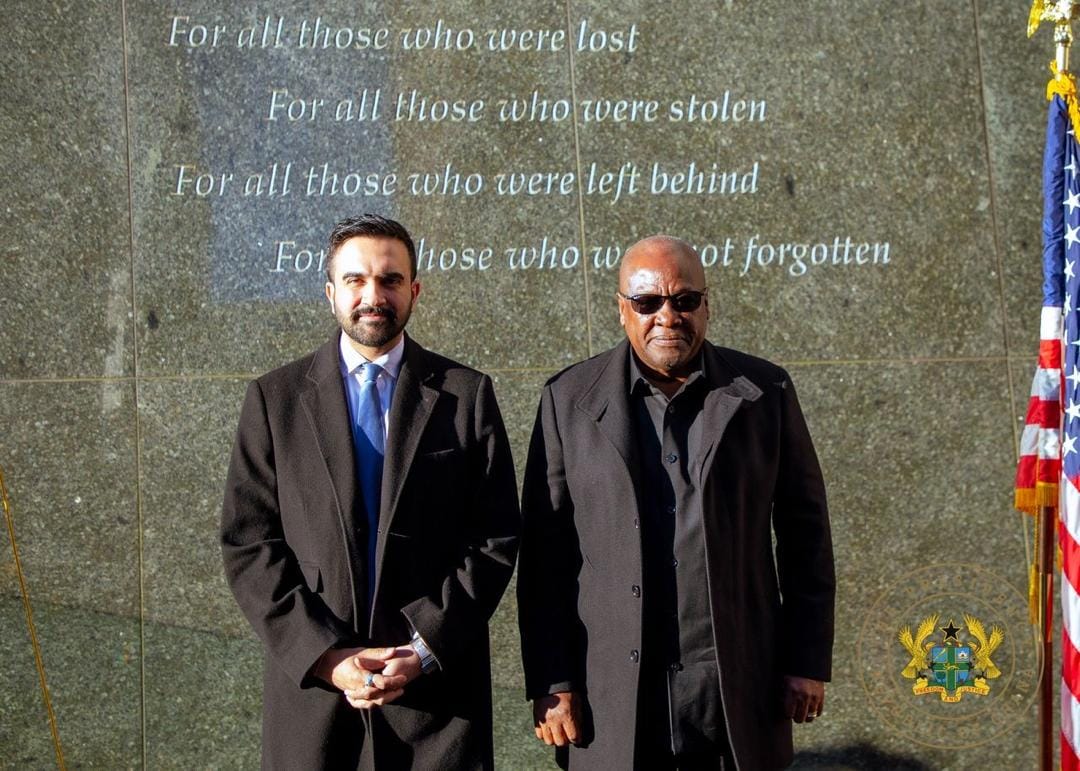
The day before Ghana's President John Dramani Mahama stepped before the United Nations General Assembly to table his Transatlantic Slave Trade resolution, he went to Lower Manhattan. On Tuesday, March 24, Mahama led a wreath-laying ceremony at the African Burial Ground National Monument — the final resting place of nearly 20,000 Africans, most of them enslaved, rediscovered beneath a federal office building in 1991. Alongside him was New York City Mayor Zohran Mamdani, civil rights leader Al Sharpton, and representatives from the African diaspora and diplomatic community.
It was a deliberate sequence. Before the vote, the memorial. Before the resolution text and the procedural politics, a moment of standing on ground where enslaved people were buried — people who left no names in the historical record, people whose labor built the city hosting the United Nations. Mahama's words at the monument connected geography directly to argument: Ghana, he noted, is home to more than 30 slave castles and forts — more than any other country on the continent. The probability is high that many of those buried in Lower Manhattan passed through the dungeons at Cape Coast or Elmina before crossing the Atlantic.
"We lay down this wreath to honour the memories of the nearly 20,000 Africans who are buried on these grounds, some of whom were free but most of whom were enslaved," Mahama said. "We lay down this wreath in remembrance of all the victims of slavery and the transatlantic slave trade — the men, women, and children who were taken from their lives and from those who loved them to be enslaved in a foreign land; and also, the people to whom they belonged, whose lives were forever altered."
The next day, the General Assembly voted 123 to 3 to formally declare the transatlantic slave trade the gravest crime against humanity — a designation that advocates say is long overdue and that carries real moral and political weight, even if it carries no legal enforcement mechanism.
The resolution, backed by the 54-member African Group, is the most explicit condemnation of the slave trade ever adopted by the world body. It describes the trafficking and racialized chattel enslavement of Africans as humanity's gravest crime by reason of "the definitive break in world history, scale, duration, systemic nature, brutality and enduring consequences that continue to structure the lives of all people through racialized regimes of labour, property and capital." It also calls on member states to pursue reparatory justice — including formal apologies, restitution, and compensation — and demands the return of cultural artifacts, artworks, monuments, and national archives taken from Africa and its diaspora.
Only three countries voted against: the United States, Israel, and Argentina. The U.S. position, articulated by Deputy Ambassador Dan Negrea, was that it "does not recognize a legal right to reparations for historical wrongs that were not illegal under international law at the time they occurred." The UK and all 27 EU member states abstained, with the EU citing legal concerns about the word "gravest" — arguing it implies a hierarchy among atrocity crimes not recognized under international law. Canada, Australia, and Japan were also among the abstentions.
The optics of the vote are striking. A 193-member body passed the resolution with 123 in favor, yet the countries most directly implicated in the slave trade — the United States, the United Kingdom, and the major European powers — either voted no or chose not to vote at all. That alignment is not incidental. It reflects an ongoing geopolitical divide over whether historical injustice creates contemporary legal obligation, and it tells you exactly which countries are most threatened by that answer.
The resolution is non-binding. It creates no legal obligation, establishes no reparations fund, and sets no payment amounts. What it does do is shift the moral frame at the most prominent multilateral forum on earth. For the reparations movement — active in Jamaica, Barbados, across the Caribbean through CARICOM, and increasingly in U.S. cities like New York and San Francisco — this is political oxygen. It is international consensus that the harm was real, structural, and ongoing. That matters in courtrooms, in legislatures, and in the long, slow work of building public will.
The resolution also calls for the return of cultural property — the sculptures, documents, and archives taken during centuries of colonial extraction. That thread connects directly to ongoing debates about museum collections in London, Paris, and Amsterdam, and adds another dimension to what "reparatory justice" actually means in practice. It isn't only financial. It's also cultural sovereignty.
The fact that New York's mayor stood at the African Burial Ground alongside the President of Ghana — on soil that once held enslaved people, blocks from Wall Street, which owes much of its early financial architecture to the slave economy — is a signal that this conversation has arrived locally as well as globally. Mayor Mamdani's presence was not incidental. New York City has been among the municipalities actively exploring reparations legislation, and having the head of a foreign state invoke that ground as part of a UN diplomatic offensive puts the city's own unresolved history into sharper relief.
Ghana's Foreign Affairs Minister Samuel Okudzeto Ablakwa was direct after the vote: "It is not about reopening old wounds; it is about ensuring that those wounds are neither forgotten nor denied." That framing — not blame, but acknowledgment — will be the political ground on which the next phase of this debate is fought.


Comments