
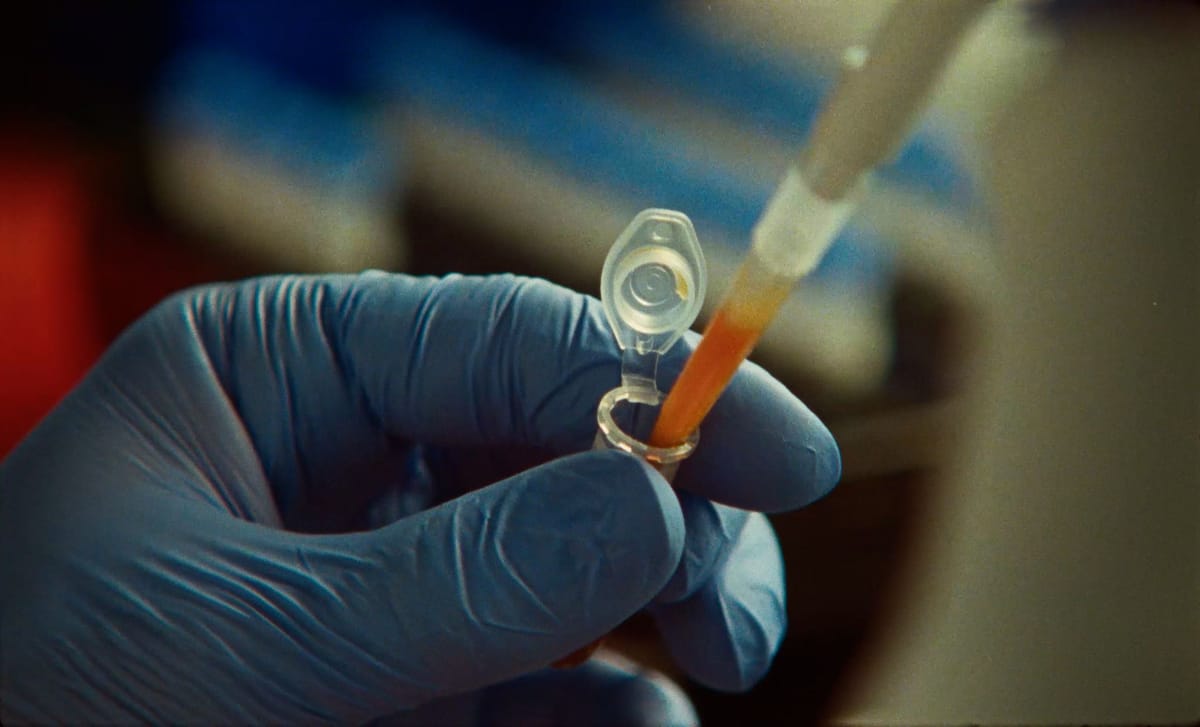
Anthropic said on Wednesday, Sept. 23, that a fleet of Claude agents identified a previously uncharacterized enzyme system in bacteriophages, the viruses that infect bacteria. The company calls it an array-associated reverse transcriptase, or ART, and announced it alongside a new life sciences research group, formed in the spring of 2026, and its wet lab.
The results are in a technical report Anthropic posted on its own site, "Autonomous AI agents discover reverse transcriptases with tandem repeat arrays". The Next Web describes it as a preprint that has not been peer reviewed.
What the agents did
According to the report, the search ran as 949 agent sessions across 119 tasks over 21.5 hours of wall-clock time, without human intervention, and used 215.6 million tokens. The campaign ran on Claude Mythos 5 through Claude Code, with worker agents overseen by supervisor agents.
The agents gathered about 200,000 reverse transcriptase (RT) clusters from a metagenomic database of 1.9 billion protein clusters. They sampled about 11,000 RT loci and scored 3,564 families of neighboring partner proteins. From there they produced 19 human-readable reports on the most promising candidates. The blog describes this as about 3,500 candidate systems narrowed to 20. "Our involvement was limited to the initial prompt and the lab work," Anthropic wrote. It said this kind of analysis typically takes an expert "weeks to months."
The report also discloses a limit. When the team ran the same campaign ten more times, the array was missed in every rerun.
What ART is
ART is made of three parts: a reverse transcriptase, a partner gene next to it, and a long array of evenly spaced DNA repeats. It turns up mainly in bacteriophages, especially jumbo phages; one example is the Staphylococcus phage SA1. Each array holds 3 to 21 copies of a repeat 15 to 49 nucleotides long, separated by spacers of 120 to 220 nucleotides. The RT sits in a family next to retrons, and the team found three unrelated types of partner protein.
The repeat array is what draws the CRISPR comparison. In an agent trace quoted in the blog, Claude wrote that the DNA next to the RT "is spectacular" and asked whether it was "a CRISPR-like … repeat array?!" The RT itself was not new. Anthropic says the enzyme had been identified in earlier studies. Claude appears to be the first to notice the array and the partner protein.
After the automated run, the team used interactive Claude Science sessions to map the family. They found 95 RT clusters, 28 of which carry arrays.
What has been tested
The lab evidence so far is limited. A public RNA-sequencing dataset from phage SA1 shows the array RNAs are highly expressed during infection, reaching up to 8% of phage RNAs 15 minutes in. In its own lab, Anthropic expressed the SA1 system on plasmids in E. coli and sequenced small RNAs, finding discrete short RNAs. The structures in the report are AlphaFold2 and Boltz-2 predictions; none has been solved experimentally.
The report states what remains open: "we have not shown that the RT is active or that the unit RNAs are its substrates. Whether the RT and its partner interact, and what the system does for the phage, are currently unknown."
The lab
Anthropic says the new research group and lab sit inside its life sciences organization alongside its drug-discovery teams. Its human scientists do all the lab work. The blog places the lab in the Bay Area, and the report lists Anthropic, San Francisco as the affiliation. The lab works only at biosafety levels 1 and 2, with no pathogens that infect humans. The report lists six authors. Anthropic has not named a leader for the group or given a headcount.
The work extends a science push that began with Claude for Life Sciences in October 2025. It arrives the same week Anthropic released Claude Opus 5.5, and follows the July report that Mythos found new weaknesses in the HAWK and AES ciphers.
What scientists said
Feng Zhang of MIT and the Broad Institute, quoted in Anthropic's post, called it "an exciting example of how AI agents can contribute to biological discovery." He said the identification of RNA-repeat arrays associated with reverse transcriptases "is genuinely intriguing and merits further investigation."
CEO Dario Amodei wrote on X, Gizmodo reported, that the company suspects the molecular machine "could represent a new gene editing mechanism," adding that its "precise function, biotechnological utility (if any), or level of significance is not yet clear."
Outside researchers weighed in. "There's nothing to indicate this is a rival to CRISPR-the-technology, or could be developed into any kind of therapeutic or practical application," Kevin Blake of Washington University School of Medicine told Al Jazeera. Stanford's Stanley Qi told the outlet that what stands out is the model's "ability to recognize an unusual biological pattern that was difficult to detect before." Writing in The Conversation, Dimitri Perrin of Queensland University of Technology said "ART is CRISPR-like in its architecture, but there is no evidence that it is CRISPR-like in its function."
Source: Anthropic, Anthropic technical report, Al Jazeera



Comments