
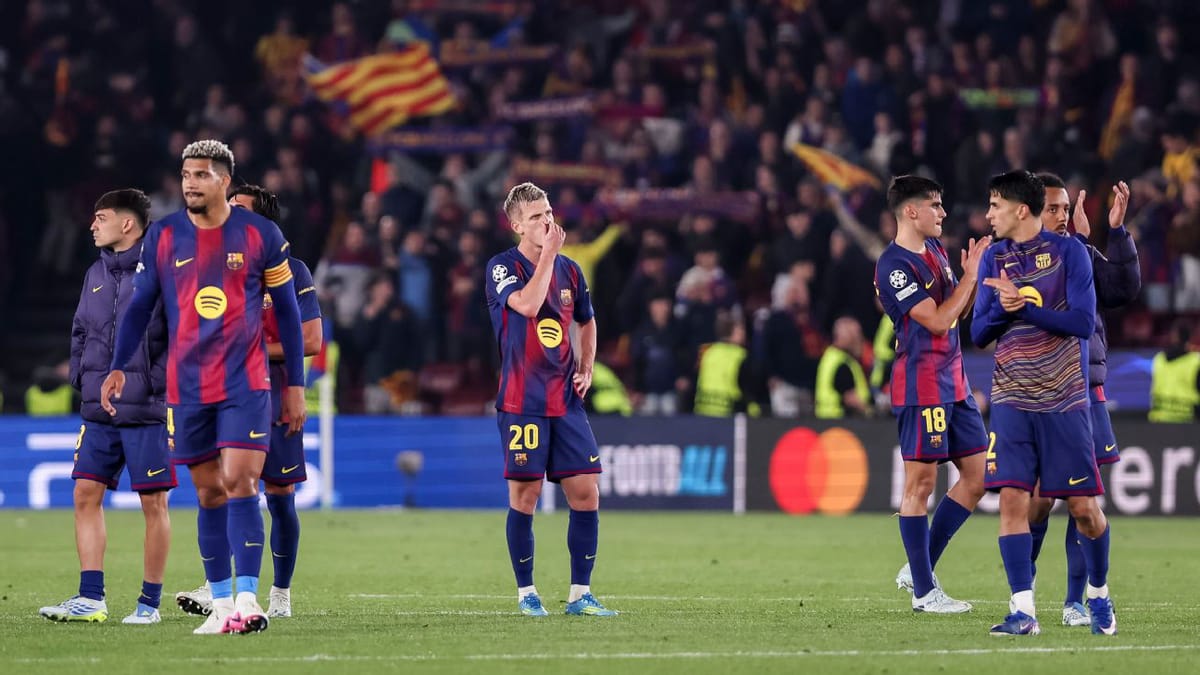
Barcelona lost to Atletico Madrid 2-0 in the first leg of their Champions League quarterfinal on Tuesday, but the result is almost secondary to the conversation it's generated. Two VAR decisions — one that gave, one that ignored — have turned a difficult loss into a full-scale controversy, and Barcelona's decision to file a formal complaint with UEFA has made sure that conversation isn't going away before the second leg.
The first moment came in the first half, when defender Pau Cubarsi received a yellow card from referee Istvan Kovacs that was subsequently upgraded to a red following a VAR review. The charge was denying an obvious goal-scoring opportunity. VAR recommended an on-field review, Kovacs looked at the monitor, and Cubarsi was off the pitch. That decision held up to scrutiny in the immediate aftermath — the replays were not kind to Barcelona's argument there.
The second moment was harder to dismiss. Marc Pubill, already booked, stopped the ball with his hand after Atletico goalkeeper Juan Musso had restarted play. Hansi Flick described it plainly after the match: "For me, it's a clear red card, well a second yellow card and a penalty." Referee Kovacs didn't call it. VAR official Christian Dingert didn't intervene. The game moved on with Barcelona a man down and no spot kick awarded.
That's the asymmetry that stings. One VAR intervention that hurt Barcelona was upheld and enforced. One that could have helped them — a potential penalty and ejection against a player already on a booking — was ignored entirely. Barcelona filed their UEFA complaint on the basis of the Pubill call, and while formal complaints rarely change outcomes, they do put the officiating record on the books.
Julian Alvarez and Alexander Sorloth scored for Atletico to make it 2-0, a lead that becomes almost impossible to overturn given where Barcelona now stand. Down two goals, having conceded clean sheets in a hostile environment, and now facing a return leg at the Metropolitano without full faith in the officiating apparatus — it's a brutal position. Hansi Flick and his staff have a week to engineer something that looks, right now, very close to impossible.
The VAR debate in European football has been cycling through this same loop for years: the tool exists to correct clear errors, but its application is inconsistent enough that it produces as many credibility problems as it solves. Tuesday in Barcelona added another data point. Whether it cost Barcelona the tie or simply cost them dignity alongside the result depends on which half of the controversy you find more convincing.


Comments