
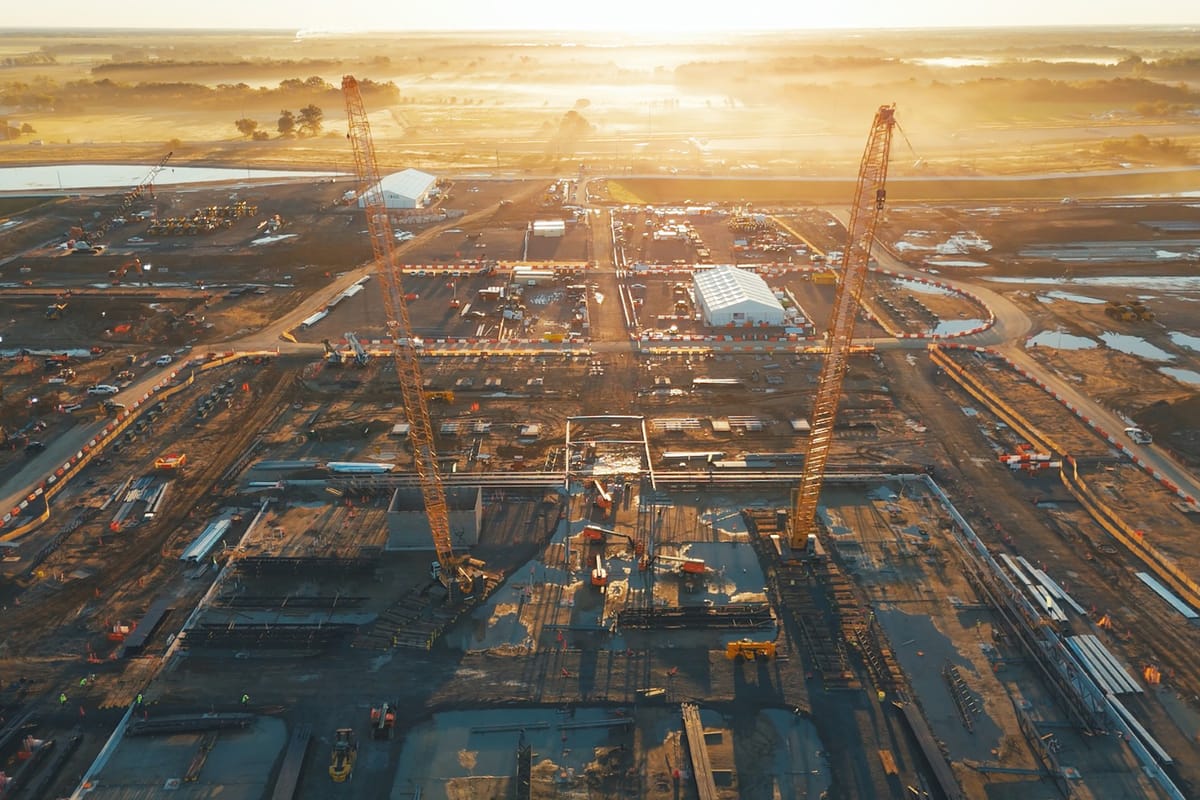
The four U.S. hyperscalers — Alphabet, Amazon, Meta and Microsoft — reported combined capital expenditures of more than $130 billion in their March quarter alone. Stretched across the full year, total 2026 capex from those four companies is projected to land near $700 billion, up from roughly $410 billion in 2025 and $230 billion in 2024. Meta alone raised its 2026 forecast to as high as $145 billion this week, an increase of more than 30% from where the company guided three months ago.
For reference: $700 billion is more than the entire 2026 federal budget for the Department of Education, the Department of Veterans Affairs, and the Department of Housing and Urban Development combined. Four private companies are about to spend that, in one year, on data centers, GPU clusters, and the cooling and power infrastructure required to keep them running.
The number is staggering. The conversation that should follow it isn't happening.
What "$700 billion in AI capex" actually buys
This isn't software spending. It's not R&D. It's heavy industrial infrastructure — buildings, transformers, fiber, gas turbines, cooling towers, and racks of NVIDIA chips that cost up to $40,000 each and depreciate fast enough that by the time a data center is fully built out, the chips inside it are already a generation behind. McKinsey estimates AI capex will require $6.7 trillion worldwide by 2030 — a number larger than the total invested in U.S. broadband, electrification, and the interstate highway system, in real dollars, combined.
The thing being built is genuinely new. Modern AI training clusters require continuous power draws of 100 to 500 megawatts — utility-scale loads that used to require dedicated industrial facilities or small cities to support. Meta's planned Louisiana facility will consume more electricity than the rest of the state combined. Microsoft has signed power purchase agreements with Three Mile Island and Constellation that effectively reserve next-decade nuclear output for its training runs. Amazon's data center demand is large enough that AWS has begun co-locating sites on top of natural gas plants in Pennsylvania to bypass grid interconnect queues entirely.
This is what $700 billion looks like in physical form. The country is building a parallel power and compute infrastructure for AI that, by 2027, will rival the energy footprint of every other commercial activity in the United States combined.
The part where investors started splitting
The market reaction to this week's earnings was the first serious sign that the hyperscaler trade is no longer a single trade. Alphabet and Amazon's shares rose Thursday on stronger-than-expected cloud growth and clear evidence that AI workloads are translating into revenue. Meta and Microsoft's shares fell. Both companies guided capex meaningfully higher; only one of them — Microsoft — has a credible enterprise AI revenue line attached.
The Meta number is particularly hard to defend. The company is now budgeting $145 billion in capex against a Reality Labs division that posted another $5 billion quarterly loss, plus a "superintelligence" research push that Mark Zuckerberg has personally framed as a bet on AGI rather than on any near-term product. The aggregate spend is more than 50% of Meta's projected 2026 revenue. Investors are starting to ask, in earnings calls and in research notes, the question that nobody asked in 2024: what return horizon are we underwriting?
The honest answer, from the people building the infrastructure, is that nobody knows. "The fast-depreciating nature of AI hardware means that there are even greater costs coming down the pike," one analyst told Fortune. The current chip generation will be obsolete in 18 months. The buildings will be undersized for the next training generation in 36. Every dollar of capex implies another dollar coming behind it just to keep pace.
Where this leaves everyone who isn't a hyperscaler
The most under-covered story inside the $700 billion number is what it does to everyone else. Mistral AI raised $830 million in debt this week just to build a single NVIDIA-powered facility outside Paris. That's a 2,500-employee European company taking on debt at a scale that wouldn't even register as a line item inside Meta's quarterly capex schedule. The capital intensity required to stay in the frontier model business has grown so quickly that the field of plausible competitors has compressed from "many" to "the four hyperscalers, plus OpenAI and Anthropic riding hyperscaler infrastructure, plus a handful of state-backed efforts."
For everyone else — every Series B AI startup, every research lab, every sovereign government trying to maintain national AI capability — the $700 billion figure functions as a moat. The economics of frontier model training have become indistinguishable from the economics of running a national grid. You don't compete with that. You partner with it, regulate it, or get out of the way of it.
SoftBank's announcement this week of a new robotics-and-AI infrastructure IPO — a vehicle that will use robots to physically build data centers and bundle SoftBank's land, energy, and digital infrastructure bets — is the cleanest read on where the next phase is heading. The frontier isn't compute anymore. It's the physical capacity to construct compute. Masayoshi Son's bet is that the next decade's value isn't captured by whoever trains the best model; it's captured by whoever owns the picks and shovels for everyone trying to.
The question nobody on the earnings calls is asking
The thing missing from every hyperscaler earnings transcript this quarter is a clearly stated thesis for what success looks like. Not "AI is the future." Not "we are committed to leading." A specific, falsifiable claim of the form: "We will know this capex was correctly sized when X happens by date Y." None of the four companies offered one.
That's worth pausing on. These are public companies allocating sums larger than the GDP of Norway, and not one of their CEOs has put on the record what return profile they're underwriting, what user behavior they expect to validate the spend, or what revenue threshold they need to clear by what year for the buildout to have been worth it. The closest anyone has come is Satya Nadella's repeated insistence that "demand is exceeding supply," which is a true statement that doesn't answer the question.
The 2000-era telecom buildout produced the same dynamic — a few years of "demand exceeds supply" rhetoric followed by a glut of dark fiber that took a decade to absorb. The dark fiber, eventually, turned out to be enormously valuable; the companies that laid it mostly went bankrupt before that value was unlocked. Whether the AI capex cycle ends with Big Tech as Verizon (the survivor that owned the underlying infrastructure once the bust cleared) or as WorldCom (the survivor's biggest casualty) is the question.
Nobody is asking it because, for now, the alternative — building less and watching a competitor build more — is unthinkable. Every CFO at every hyperscaler is making the same calculation: the cost of overbuilding is dilution, the cost of underbuilding is irrelevance, and dilution is recoverable.
$700 billion this year. Probably $1 trillion next. The largest infrastructure buildout in modern history, conducted in public, by private companies, with no agreed-upon definition of "enough."
It will be a good investment, or it will be the most expensive coordination failure in capital markets history. Right now, those two outcomes are indistinguishable from each other on the income statement.
Related on Uristocrat: Google's Aluminium OS launch.
One piece of the older, cheaper stack is being switched off as that spending climbs — Amazon is closing Mechanical Turk after 21 years.


Comments