
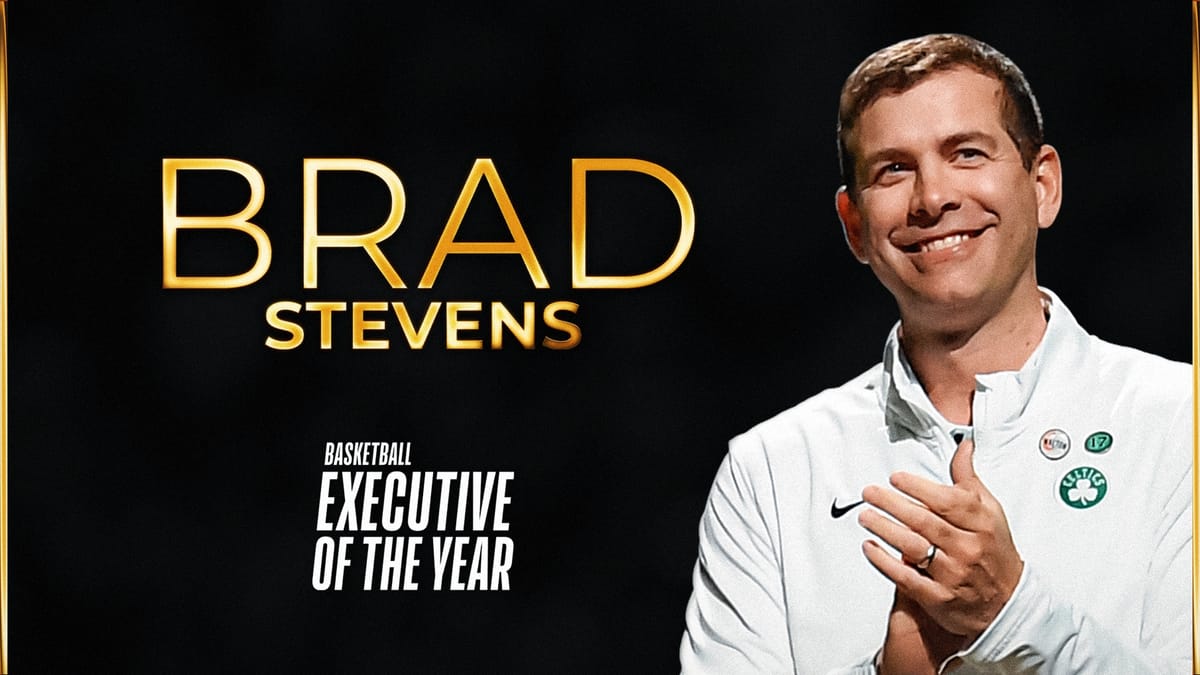
The Boston Celtics' President of Basketball Operations Brad Stevens won his second NBA Executive of the Year award Tuesday, taking 11 of a possible vote ballots to easily clear Atlanta's Saleh Onsi and Detroit's Trajan Langdon. NBA.com has the full vote breakdown. He becomes the 12th executive ever to win the honor multiple times.
The headline number — 56-26, second-best record in the East — buried the lead. The actual achievement is what Stevens did to the cap sheet on the way to that record.
The $352 Million Move
The Celtics walked into 2025-26 staring down a projected $540 million combined payroll-and-luxury-tax bill. They walked out at $187.8 million. That is not a trim. That is a structural reset that simultaneously cleared Boston off the second apron, eliminated their luxury tax obligation outright, and reset the runway on repeater penalties for future spending. NBC Sports Boston has the cap math.
To do that, Stevens traded Jrue Holiday and Kristaps Porzingis. He let Al Horford and Luke Kornet walk. He kept the team's two All-NBA pillars in Jaylen Brown and Jayson Tatum, elevated Payton Pritchard into a starter's role, signed Neemias Queta out of free agency into a starting-five spot with elite advanced metrics, and used four end-of-bench rotation slots on rookies — Hugo Gonzalez, Baylor Scheierman, Jordan Walsh, Ron Harper Jr. — who actually contributed. Brown himself climbed into MVP-level production for stretches.
The Celtics finished one game behind Cleveland in the East. Boston is currently up 3-1 on Philadelphia and a closeout away from the second round. None of that should be possible coming off a roster that just shed two starters and two key reserves.
Why Every GM Is Now Studying This
The 2023 CBA's second apron was designed to do exactly what it has done to the Suns, Bucks, and Timberwolves: punish team-building inflexibility with hard caps on trade aggregation, drafted-player matching, and the freezing of future first-round picks. The conventional wisdom has been that contenders either go all-in and accept the apron's cage, or run it back at a lower competitive ceiling.
Stevens has produced a third option. Strip the cap sheet to ribbons mid-cycle, replace exits with internal development and minimum-priced veteran slots, hold onto the two superstars, and stay competitive enough that the front office gets another full window to operate inside before the next big bill comes due. Boston is now positioned to spend aggressively again next summer if Tatum and Brown remain healthy and the rookie cohort proves out — exactly the optionality the second apron was supposed to make impossible.
The reason Sam Presti got the award in 2025 is the reason Stevens got it again in 2026: this is a generation of front offices being judged less on who they sign than on what cap structure they leave behind. Stevens did not just save Wyc Grousbeck's wallet. He produced the most replicable case study any defending-window team has had on how to navigate the new financial regime without surrendering the season.
The Stevens Quote
"These awards are organizational awards, and everyone in this building shares in this recognition. I am just thankful to be there in a support role for our players, coaches and staff."
That is on-brand and beside the point. The interesting reading is that Stevens spent his 13 years on Beacon Hill being told he was a coach who lucked into a front-office seat. He is now the only executive of the post-CBA era with two trophies, the only one who has done it on a team that had recently won a title, and the architect of the playbook that is going to define the next three offseasons league-wide.
The Celtics close out Game 5 against the 76ers at TD Garden tonight. Schedule via NBA.com. The trophy is timed perfectly.
Related on Uristocrat: the Knicks reaching their first NBA Finals since 1999.

Comments