
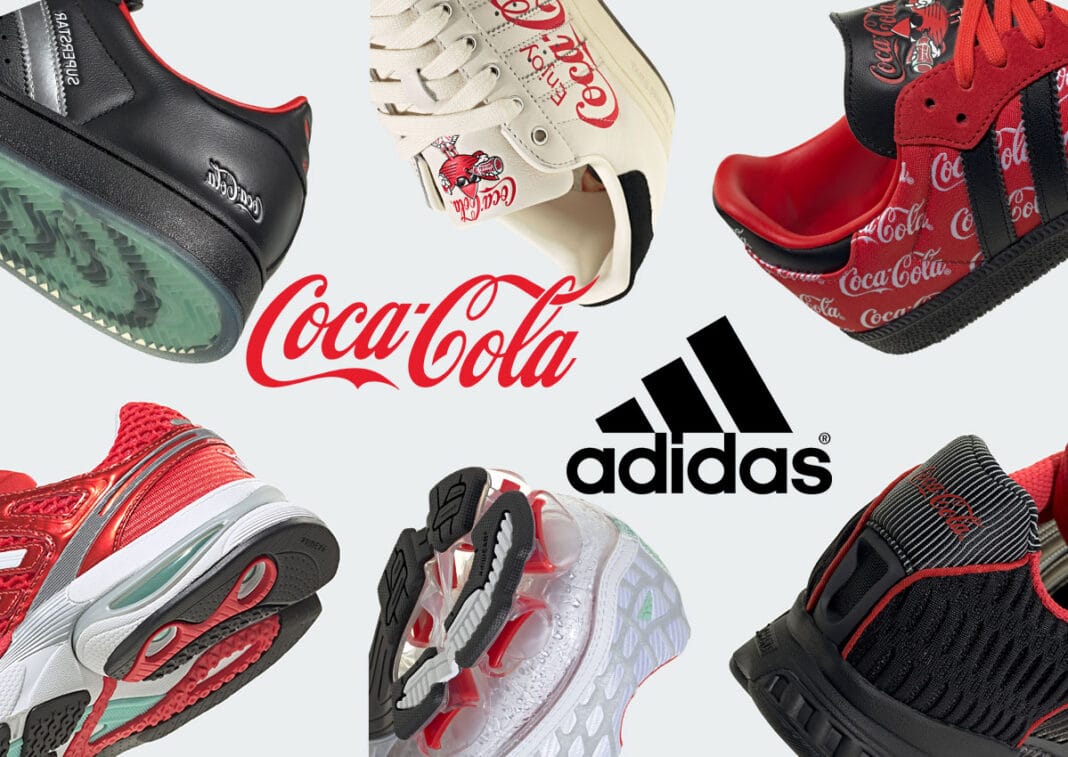
adidas Originals will release its Coca-Cola collaboration on June 3, 2026, with an official announcement expected before the end of May. The collection spans six silhouettes — the Samba, Superstar, Superstar II, Adistar Control 5, Megaride F50, and ClimaCool 1 — wrapped in Coca-Cola's instantly familiar palette of red, white, black, metallic silver, and cream.
What's in the collection
The lineup splits between loud and subtle. The Adistar Control 5 leans maximal, with bold red mesh and metallic silver overlays. The Superstar II goes the other way — cream leather, black heel tabs, and large "Enjoy Coca-Cola" script across the upper. The Megaride F50 is the most playful of the group: a translucent cushioning unit printed with water-droplet graphics, engineered to read as a cold drink on a hot day. Vintage Coca-Cola branding and retro detailing run throughout.
Two nostalgia machines, pointed at each other
The interesting thing here is not the shoes. It is the logic. Coca-Cola does not need sneaker relevance, and adidas does not need Coca-Cola's distribution. What each brand has that the other wants is recognition without context — the ability to put a mark on a product and have a billion people feel something before they think anything.
adidas has spent the last three years turning the Samba into exactly that kind of mark, and it is now actively looking for ways to extend the silhouette's life beyond its current peak. We saw that instinct in the Toy Story collaboration, where adidas attached the Samba to a family-movie campaign that would run on cable all spring. Coca-Cola is the same play at a larger scale: borrow a logo so universal it carries no risk, and let the co-sign do the work a marketing budget used to.
Why it matters
This is what the collaboration era looks like in its mature phase. The early wave of adidas team-ups — artists, designers, athletes — added something the brand did not have: subculture credibility, a point of view. A Coca-Cola collection adds nothing adidas lacks. It is a nostalgia exchange between two companies that are each, in 2026, mostly selling their own history. The shoes will look great in photographs. Whether the collaboration means anything is a harder question — and increasingly, for the biggest brands, not one they are asking.

Comments