
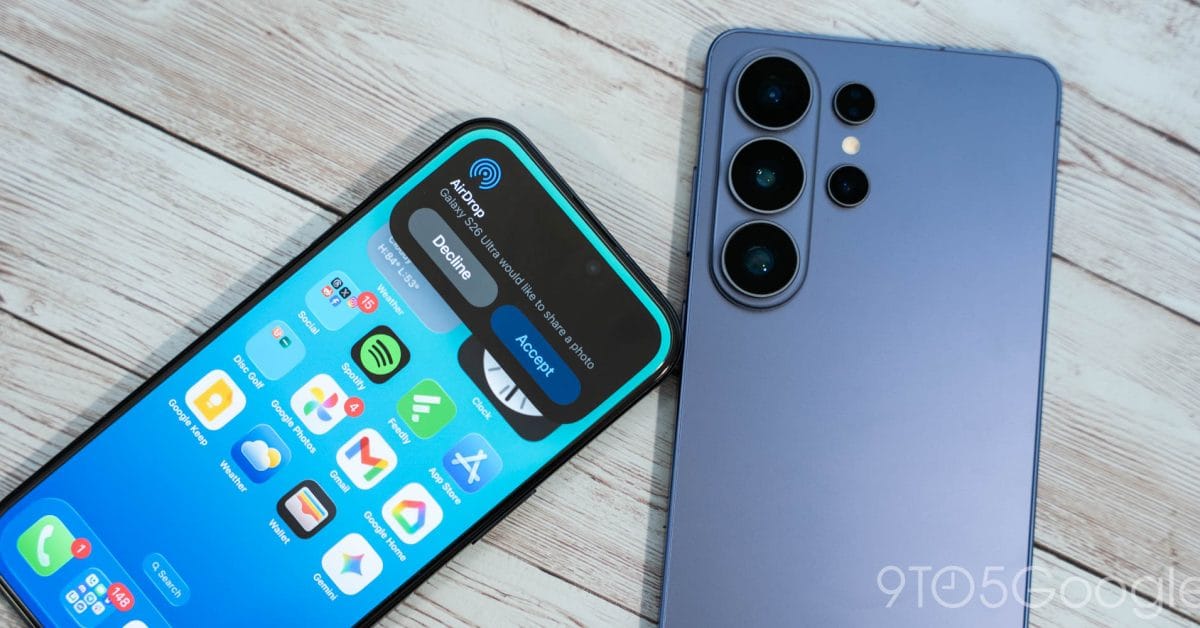
Google confirmed on May 12 that it is expanding Quick Share's AirDrop compatibility well beyond Pixel phones in 2026, bringing cross-platform file sharing between Android and iOS to devices from Samsung, OnePlus, Oppo, Vivo, Xiaomi and Honor. The Galaxy S26 lineup already got it in March; the rest of the Android ecosystem follows this year.
The most annoying wall in consumer tech is coming down
For more than a decade, sending a photo from an iPhone to an Android phone meant a worse experience on purpose. AirDrop worked beautifully — as long as everyone in the room had an Apple device. Quick Share worked beautifully — as long as nobody did. The gap was not a technical limitation. It was a feature of Apple's strategy, the same friction that makes the green-bubble divide and the "switch to iPhone" pressure work.
What makes this announcement notable is who solved it. Google says it built the AirDrop interoperability itself, and a QR-code cloud-share fallback already lets any Android phone push a file to an iPhone today. Apple did not open a door; Google walked around the wall.
Interoperability is becoming the default — by force or by choice
This is the second front in a broader unwinding of the walled garden. Regulators in the EU have spent two years forcing Apple to open iMessage adjacencies, sideloading and default-app choices. Google's move is the market-driven version of the same pressure: rather than wait for a mandate, it is simply making the closed ecosystem look like the inconvenient one.
For the affluent consumer who carries an iPhone but lives in a mixed-device household — an Android-using partner, a Windows laptop, kids on hand-me-down Samsungs — the practical win is real. The strategic shift is bigger. Hardware lock-in built on small daily frictions is the model that has powered Apple's ecosystem for fifteen years, and it depends on those frictions being unfixable. They are turning out to be very fixable. It is the same logic reshaping the AI hardware race, where Qualcomm is supplying chips across competing platforms rather than betting on one.
AirDrop will still be AirDrop. But the thing that made it powerful — that it only worked inside Apple's fence — is quietly ending.



Comments