
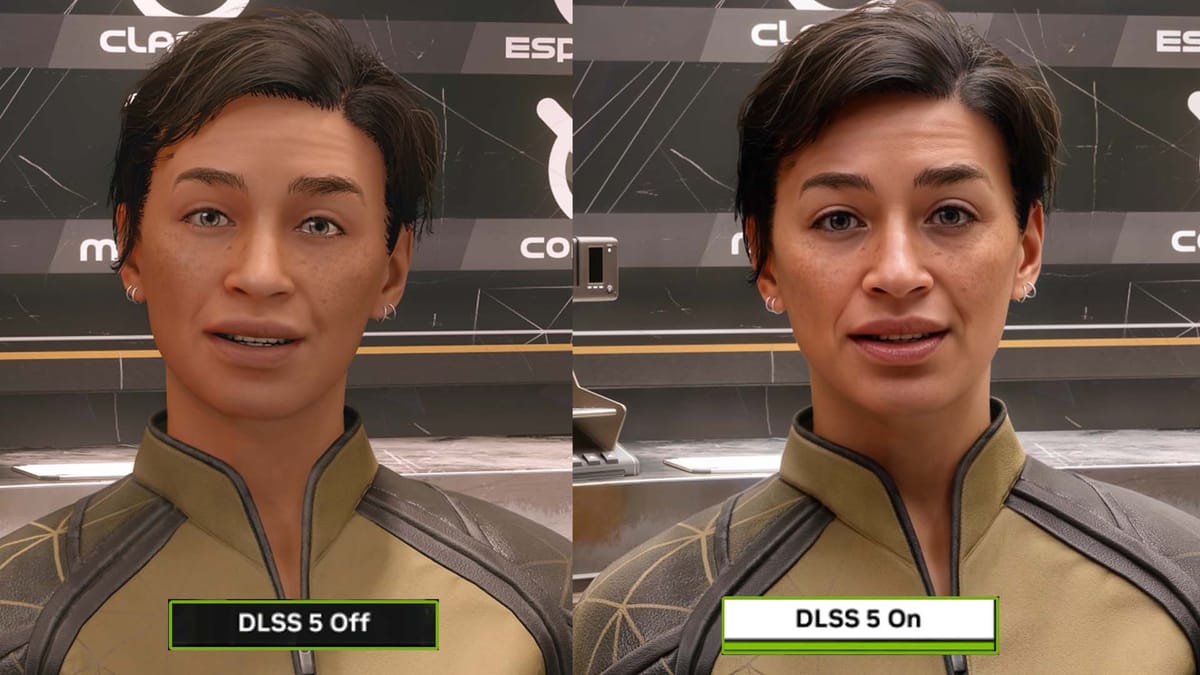
NVIDIA unveiled DLSS 5 at GTC 2026 last week as what CEO Jensen Huang called a "fusion of 3D graphics and artificial intelligence" — a neural rendering technology that takes existing game assets and enhances them with photorealistic lighting and materials. The reaction from the gaming community was immediate and hostile. Screenshots of updated character models in Resident Evil 9, particularly the redesigned versions of Leon Kennedy and Grace Ashcroft, drew widespread comparisons to generative AI filters. The consensus online: this is AI slop.
Huang's initial response was combative. He told Tom's Hardware that critics were "completely wrong," arguing that DLSS 5 is not a post-processing filter applied to a finished frame, but a generative system conditioned on 3D geometry and developer-controlled artistic intent. The distinction matters because it's the difference between a tool that enhances what artists built and one that substitutes its own aesthetic on top of it. By Huang's framing, DLSS 5 respects the source material. It just makes it more photorealistic.
Then Nvidia's own GeForce Evangelist, Jacob Freeman, told a YouTuber in writing that DLSS 5 takes a 2D frame plus motion vectors as input and that it is "analyzing a single frame." That's substantially different from what Huang described. If DLSS 5 is working from a flat 2D image with no access to the underlying geometry — essentially taking a screenshot and inferring what the lighting and surfaces should look like — that's much closer to the generative AI filter critics described.
On Lex Fridman's podcast Sunday, Huang shifted to a more conciliatory tone: "I don't love AI slop myself." He maintained that DLSS 5 is 3D-conditioned and developer-controlled, but acknowledged why the criticism makes sense. That's the right instinct. The demos Nvidia chose — particularly Resident Evil 9 — were not the strongest case for the technology. Characters looked smoother, softer, and more homogenous in ways that felt less like enhancement and more like replacement. NVIDIA has until fall to show the gaming community what DLSS 5 looks like when developers have full control over the implementation. That demo will matter more than anything Jensen says on a podcast.
On the hardware side of the business, Huang has forecast that Nvidia will sell twice as many chips next year.




Comments