
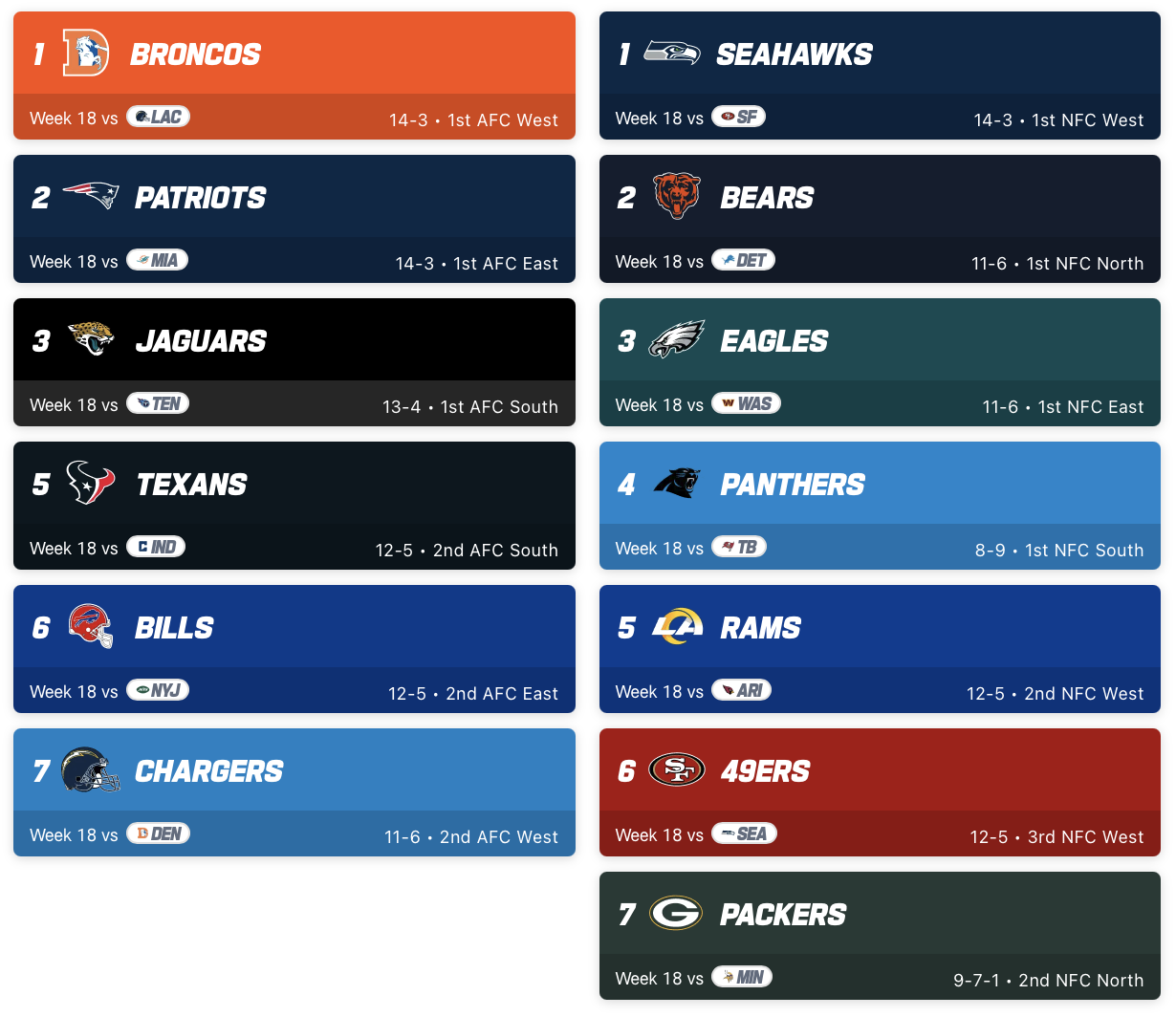
The 2026 NFL playoffs begin January 10 with wild-card weekend, featuring the most open postseason field in recent memory following Kansas City's elimination—marking the first time in 11 years the Chiefs miss the playoffs and ending Patrick Mahomes's eight-year postseason streak.
AFC
No. 1 Denver Broncos (14-3) first-round bye
No. 7 Los Angeles Chargers (11-6) at No. 2 New England Patriots (14-3), 8 p.m. Sunday, NBC
No. 6 Buffalo Bills (12-5) at No. 3 Jacksonville Jaguars (13-4), 1 p.m. Sunday, CBS
No. 5 Houston Texans (12-5) at No. 4 Pittsburgh Steelers/Baltimore Ravens winner, 8 p.m. Monday, ESPN/ABC
NFC
No. 1 Seattle Seahawks (14-3) first-round bye
No. 7 Green Bay Packers (9-7-1) at No. 2 Chicago Bears (11-6), 8 p.m. Saturday, AMAZON PRIME
No. 6 San Francisco 49ers (12-5) at No. 3 Philadelphia Eagles (11-6), 4:30 p.m. Sunday, FOX
No. 5 Los Angeles Rams (12-5) at No. 4 Carolina Panthers (8-9), 4:30 p.m. Saturday, FOX
The playoff schedule follows traditional format: wild-card round January 10-12, divisional round January 17-18, conference championships January 25, and Super Bowl LX February 8 in Santa Clara. Fourteen teams advance—seven per conference—with top seeds earning first-round byes.
The bracket structure uses reseeding after wild-card weekend rather than fixed positioning, meaning the lowest remaining seed faces the #1 seed regardless of initial matchup outcomes. This format rewards regular-season dominance while maintaining competitive balance through bracket fluidity. Seattle's 13-3 victory over San Francisco secured NFC's #1 seed and first-round bye, positioning the Seahawks as defensive anchor heading into knockout rounds. The defense limited Christian McCaffrey to 23 rushing yards while quarterback Sam Darnold managed efficient 20-of-26 passing performance, demonstrating the complementary balance underlying Seattle's 14-3 regular season.
Chicago claims #2 seed at 11-5 despite Week 18 loss, Philadelphia settles at #3 following their own defeat, and Carolina captures NFC South as #4 seed. Denver leads AFC playoff positioning despite final seeding uncertainty entering Week 18, requiring only victory or losses by New England and Jacksonville to secure #1 seed and conference's only first-round bye.
The Broncos' defensive excellence—allowing fewest points and yards per game league-wide—establishes them as legitimate Super Bowl contender in Chiefs' absence. New England's surprising resurgence claims AFC East crown over Buffalo, while Jacksonville's Trevor Lawrence pursues AFC South title.
Houston Texans position as potential #4 seed if Jacksonville falters against Tennessee, demonstrating how competitive balance extends through wild-card positioning. The AFC's final playoff spot awaits resolution from Ravens-Steelers Sunday night matchup determining AFC North champion. Baltimore controls fate—victory claims division title and #4 seed, defeat eliminates them entirely. Pittsburgh similarly faces binary outcome after squandering division-clinching opportunity with Cleveland loss. The winner-take-all format represents NFL's competitive compression: teams separated by minimal regular-season performance differential face elimination-or-advancement outcomes based on single-game execution.
Wild-card weekend features broadcast distribution across CBS, Fox, NBC, ESPN, and Amazon Prime Video, with six total games spanning Saturday through Monday. The divisional round consolidates to four games split between CBS, Fox, NBC, and ESPN on January 17-18, before conference championships on CBS (AFC) and Fox (NFC) January 25. Super Bowl LX on NBC February 8 represents culmination of expanded playoff field introduced in 2020 expansion from 12 to 14 teams.
Philadelphia enters as defending champions seeking repeat, though their inconsistent regular season raises questions about sustainable excellence versus previous year's championship form. The playoff structure rewards divisional performance through guaranteed top-four seeding for division winners regardless of record, creating scenarios where wild-card teams possess superior records to lower-seeded division champions.
Comments