
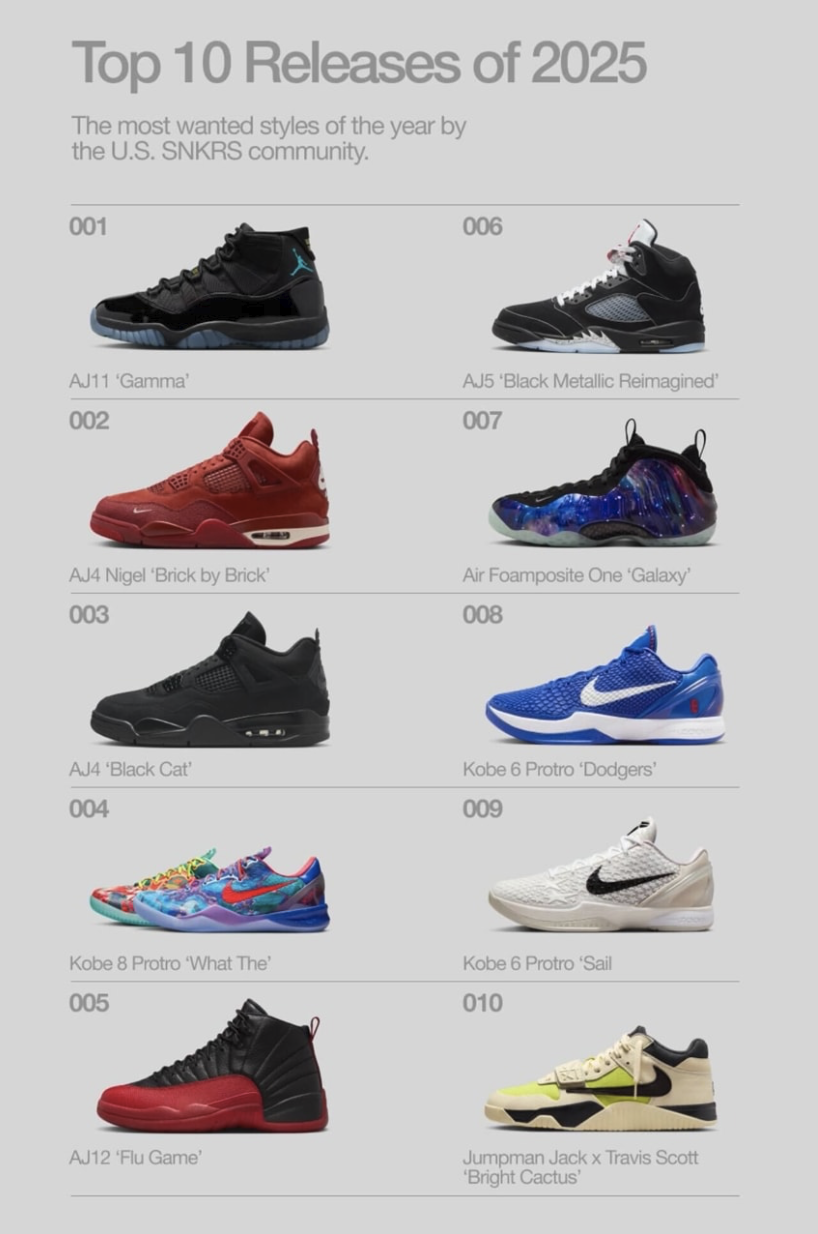
Nike's fourth annual SNKRS year-end recap reveals a fundamental strategic recalibration away from collaboration dependency toward heritage monetization, with the Air Jordan 11 "Gamma" claiming the platform's top position for 2025—marking the first time the silhouette has appeared on these annual rankings and ending Travis Scott's three-year stranglehold on the number one spot.
The complete absence of Air Jordan 1s from the top ten, following 2024's four entries and years of collaboration-driven dominance, signals not merely a cyclical shift in consumer preference but a calculated institutional repositioning toward what Nike frames as "authentic" cultural artifacts rather than celebrity-mediated scarcity. Only two collaborations penetrated the rankings—Nigel Sylvester's "Brick by Brick" Air Jordan 4 and Scott's "Bright Cactus" Jumpman Jack—representing a collapse from the previous three-year average of 77% collaboration entries to just 20%, while six retro reissues matched the combined total from the prior three years. This data-driven recalibration positions Nike's archive as the primary authentication mechanism rather than celebrity endorsement, weaponizing institutional memory and generational nostalgia as commercial infrastructure.
The complete dominance of basketball-related product across all ten entries—six from Jordan Brand, four from Nike Basketball's Kobe and Foamposite lines—reinforces how basketball heritage functions as Nike's most reliable cultural currency, particularly as the Kobe 6 and 8 Protro models claim three spots despite years of market presence. The Air Jordan 4's continued momentum through both the "Black Cat" general release and Sylvester's Queens-centric storytelling approach demonstrates the model's versatility as both mass-market retro vehicle and a collaboration platform, effectively claiming the institutional authority previously held by the Air Jordan 1. What Nike frames as consumer-driven demand—measured through SNKRS raffle entries from U.S. users—reveals how the platform's algorithmic curation and regional drop strategies manufacture the appearance of organic hype around predetermined heritage narratives, with the "Gamma" 11s benefiting from fourth-quarter regional releases and 30th anniversary marketing infrastructure. The institutional apparatus positions 2025 as the year nostalgia economics formalized as corporate strategy, with younger consumers seeking connection to pre-existing cultural narratives rather than participating in real-time celebrity collaboration cycles, validating Nike's archival authority as the dominant mechanism for cultural legitimacy within contemporary sneaker infrastructure.
Comments