
Key Points
- Nvidia unveiled its first PC chip, RTX Spark (also called N1X), with MediaTek at Computex.
- Shares of Intel, AMD and Qualcomm fell; Nvidia rose more than 6%.
- CEO Jensen Huang said Nvidia and Microsoft will "reinvent the PC."
- The chip debuts later in 2026 in Windows PCs from Dell, HP, Asus, Lenovo and MSI.
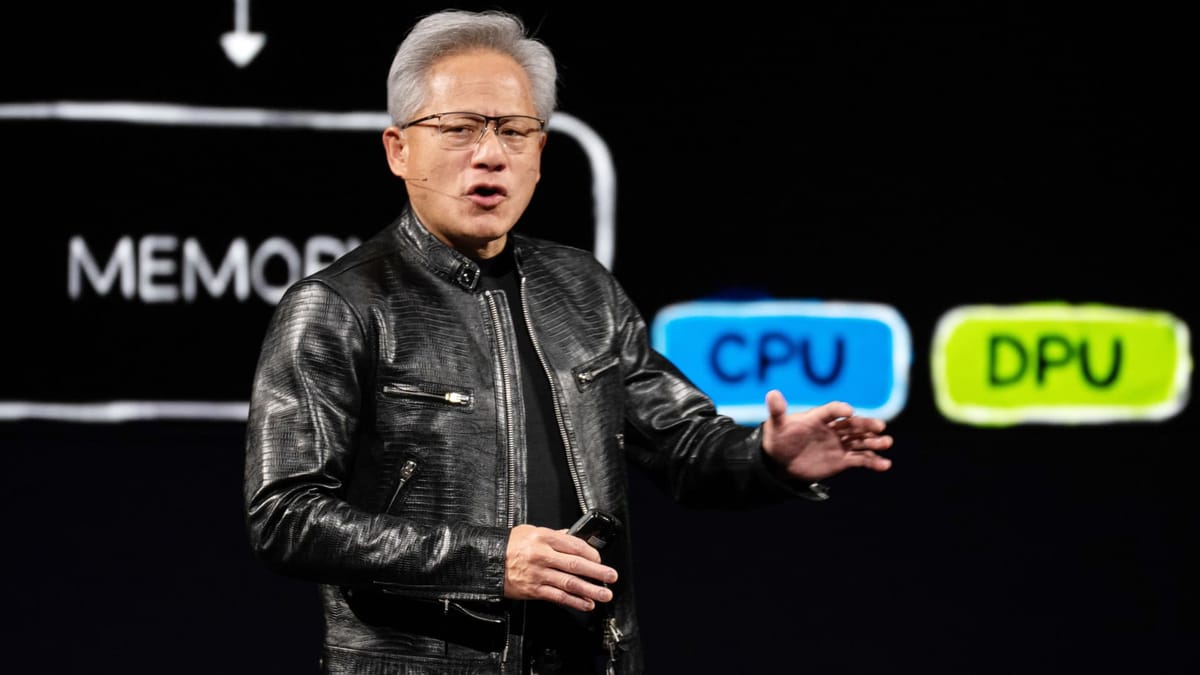
Nvidia built a $5.4 trillion market cap selling the data center its AI boom runs on. On Monday at Taiwan's Computex, Jensen Huang announced he wants the rest of the stack too. Standing on stage, the CEO said Nvidia and Microsoft are going to "reinvent the PC" — and the market read it instantly as a threat, sending Intel, AMD and Qualcomm shares down while Nvidia's popped more than 6%.
The chip
The product is called RTX Spark, which Huang also referred to as the N1X — a system-on-chip built with Taiwan's MediaTek that pairs Nvidia's Blackwell GPU with a MediaTek CPU on a single die. Its headline feature is unified memory, letting the CPU and GPU draw from the same pool and removing a bottleneck that has capped how large a model a laptop can run locally. RTX Spark debuts later in 2026 in a new line of Windows machines from Microsoft, Dell, HP, Asus, Lenovo and MSI.
Owning every layer
"Nvidia getting into the space is Jensen recognizing that he wants to own every bit of the AI stack in some shape," IDC analyst Tom Mainelli told CNBC. The logic is the edge: as AI shifts from cloud chatbots to agents that run continuously in the background, Huang's pitch is that those agents run cheaper on the device than in the cloud. He held up a small Nvidia-powered MSI computer and said an agent could run "24/7, meter free. No meter anxiety." The reframe is the move — the PC stops being a productivity box and becomes the thing your personal agents live on.
The Arm story underneath
RTX Spark is also a milestone for Arm over the x86 architecture Intel pioneered in the 1970s. Nvidia tried to buy Arm for $40 billion in 2020 — regulators killed it — in what now looks like a preview of exactly this ambition. Apple ditched Intel x86 for its own Arm chips, Amazon, Google and Microsoft built Arm CPUs for their data centers, and Huang now pegs the total CPU market at a coming $200 billion. The duopoly that ran computing for forty years is being attacked from the AI side.
The reality check
None of this is money for Nvidia yet. Analysts estimate its networking business alone is at least 20 times the size of its PC business will be near-term, and one Seaport analyst has a sell rating, expecting no material PC numbers "any time soon." Cracking a market controlled by Intel, AMD, Qualcomm and Apple is hard, and the "AI PC" Microsoft pitched in 2024 never sparked a refresh cycle. But Nvidia brings the one thing prior challengers lacked — the GPU credibility that the entire cloud AI build runs on, the same capital story driving deals like Anthropic's $965 billion valuation. That same wave of capital is funding Nvidia's would-be challengers in silicon: SambaNova raised a $1 billion Series F at an $11 billion valuation for its AI inference chips, with JPMorgan as an inference-infrastructure partner. Analyst Pat Moorhead called RTX Spark "the closest thing to take on the MacBook Pro for the Windows ecosystem." For a company that has never lost an AI fight, that is the whole bet.
Nvidia's expansion beyond the data center continued when it agreed to acquire Hugging Face for $12.93 billion, its second-largest acquisition on record. AMD answered with a research-talent play of its own in September 2026, agreeing to acquire Fei-Fei Li's World Labs for $8.2 billion — its own second-largest deal ever — bringing Li in as chief scientist as the two chipmakers race to control not just silicon but the AI research shaping what runs on it.
Source: CNBC

Comments