
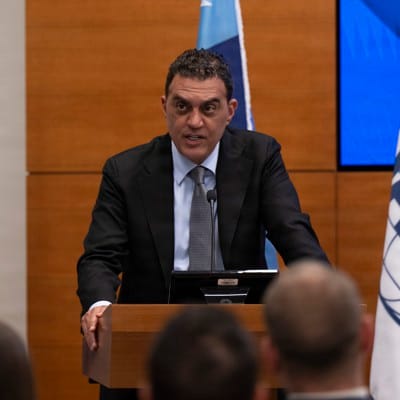
On May 7, 2026, at the Special Competitive Studies Project's AI+ Expo in Washington, D.C., Emil Michael — Undersecretary of Defense for Research and Engineering — formalized what eight days of Pentagon procurement had already implied: the Department of War is not coming back to Anthropic, regardless of how good Claude Mythos turns out to be.
The Quote
Michael's exact framing, on stage:
"We were single-threaded on one vendor, one AI vendor at the Department of War… But never again we'll be single-threaded with any one model."
He characterized the May 1 contracts with eight other vendors — OpenAI, Google, Microsoft, Amazon Web Services, Nvidia, SpaceX, Meta, and Reflection AI — as a deliberate "counterstatement" to Anthropic. The Pentagon's May 1 procurement decisions were the action; Michael's May 7 remarks are the doctrine.
What Makes This Statement Different
The Anthropic-Pentagon dispute has been on Uristocrat's radar since the lawsuit landed in March. The shape of that fight has been clear: Anthropic refused to grant the Pentagon unrestricted Claude access for fully autonomous weapons systems and mass domestic surveillance, the Pentagon designated Anthropic a "supply chain risk" — a label previously reserved for foreign-adversary-linked vendors — and Anthropic sued. A federal judge in California blocked the White House's attempt to force-remove Anthropic products from federal use while litigation proceeds.
What changed on May 7 is the Pentagon's posture toward reconciliation. Until this week, the official line was that the relationship was paused while contract terms were renegotiated. Michael's statement closes that door explicitly. Even with the White House quietly softening its tone on Anthropic and drafting policies that permit federal agency use of Mythos, the Pentagon's research and engineering chief is now on record saying it doesn't matter — the procurement decision is structural, not tactical, and reversing it would re-introduce single-vendor risk the department is no longer willing to accept.
The Mythos Twist
The unusual part of Michael's remarks: he didn't dismiss Mythos. He elevated it. Per his own words on stage, Mythos Preview demonstrates "groundbreaking ability to spot cyber vulnerabilities" and represents "a cyber moment" for how the U.S. government will address cybersecurity challenges. The Pentagon's #2 R&D official is publicly endorsing the technical capability of a vendor he just ruled out reconciling with.
That's the contradiction the rest of the AI policy world has to absorb. Mythos is — by Michael's own assessment — too good for the federal government to ignore on cybersecurity. Project Glasswing, Anthropic's controlled access program for AWS, Apple, Cisco, Google, JPMorgan Chase, and Microsoft, is doing the work the Pentagon would benefit from most. And the Pentagon is choosing the structural answer (no single vendor, ever) over the tactical one (use the best tool for the job).
What This Means for Anthropic
Anthropic's commercial trajectory does not depend on the Pentagon. The company crossed $30B in annualized revenue in April, surpassing OpenAI's $24B for the first time, and the bulk of that growth is enterprise — the financial agents launched last month, the Glasswing partners, the AWS and Google Cloud commitments. Losing the Department of War as a customer is a strategic loss in narrative terms, not a financial one.
But "narrative terms" is doing a lot of work. The Pentagon endorsing or rejecting an AI vendor is signal that ripples across allied governments, defense contractors, and any commercial customer with a national security exposure. Anthropic's bet — that holding the line on autonomous weapons and mass surveillance is worth the federal procurement freeze — is being publicly tested at higher temperature now than it was when the lawsuit dropped. Michael's statement is the test result: the company's ethics line is real, the Pentagon's response is permanent, and both sides have decided this is the world they'd rather operate in.
The Take
The Anthropic-Pentagon split is the cleanest case study we have of an AI lab operationalizing a stated values commitment at the cost of a marquee customer. Every other major lab — OpenAI, Google, Microsoft, xAI — said yes to the contract terms Anthropic refused. That's now a public, doctrine-level distinction in the AI market. Customers who care about it will know exactly where to find Anthropic. Customers who don't, won't.
The longer story is whether the Pentagon's "never again single-threaded" posture survives contact with reality. If Mythos keeps doing what Michael says it does on cybersecurity, the cost of refusing to use it accumulates. We'll see whether structural commitment beats tactical advantage over the next eighteen months.

Comments