
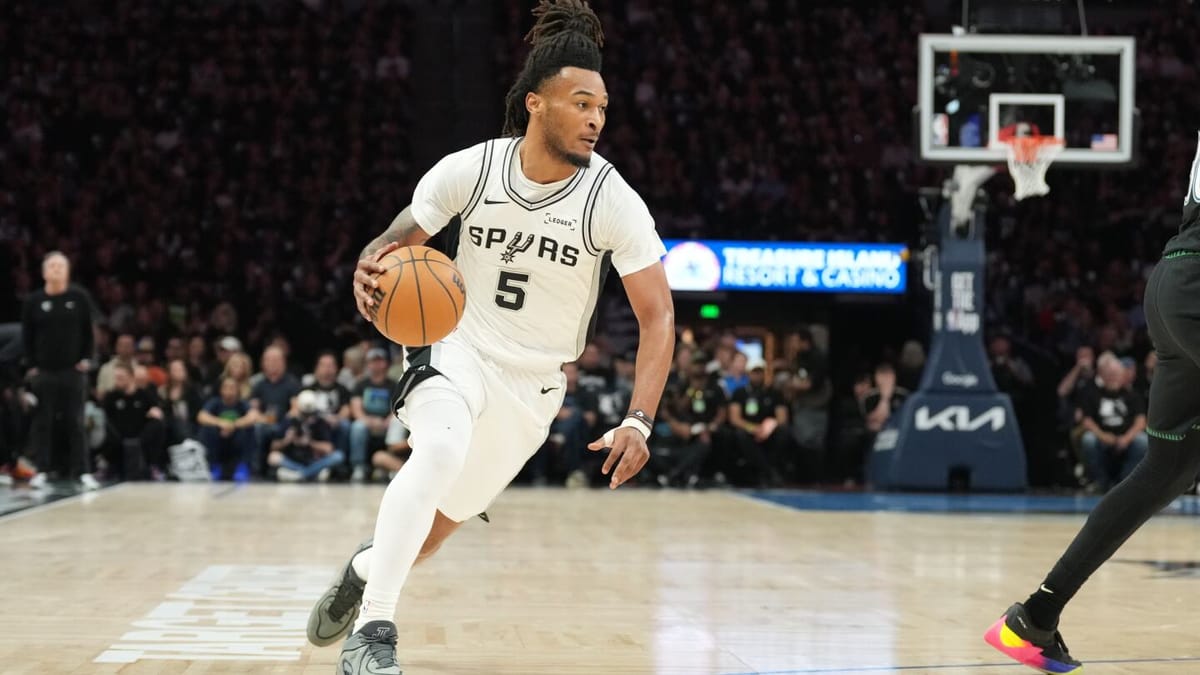
San Antonio is four wins from the NBA Finals. The Spurs closed out the Minnesota Timberwolves 139-109 in Game 6 on Friday night to take the Western Conference semifinal series 4-2. The 30-point margin was no fluke: they never trailed by double digits all series.
The game
Stephon Castle was the engine: 32 points on 11-of-16 shooting, a perfect 5-of-5 from three, plus 11 rebounds and 6 assists. De'Aaron Fox added 21 points and 9 assists, Julian Champagnie scored 18 on four threes, and rookie Dylan Harper chipped in 15 off the bench. Victor Wembanyama finished with 19 points and his usual paint-warping defensive presence.
Anthony Edwards led Minnesota with 24 points on 9-of-26 shooting, a line that captured the whole series. The Wolves' best player spent six games grinding for hard-earned looks against a defense engineered specifically to take them away.
How they got here
The series was never close in aggregate. San Antonio outscored Minnesota by 97 points across the six games, controlling tempo with a relentless, switch-heavy defense that turned Minnesota's halfcourt sets into long, contested possessions. Wembanyama set the tone early, including a 126-97 Game 5 rout that left the Wolves needing a road win they were never built to get.
What it means
This is the part worth sitting with: the Spurs are in the conference finals ahead of schedule. The roster that was supposed to be a year or two from contention, Wembanyama, Fox, Castle, Harper, has instead arrived early, and it arrived by defense, the slowest and least flukey way to build a winner. Castle's emergence as a two-way force gives San Antonio a second creator who does not need the ball to matter.
The reward is brutal. San Antonio faces defending champion Oklahoma City in the Western Conference Finals, with Game 1 on Monday at Paycom Center. The Thunder swept both their opening series and have had a week of rest. The Spurs are the story of the postseason; the Thunder are the measuring stick for whether the story has another chapter.
Why the Wolves lost the series
San Antonio's switch-heavy scheme did to Edwards what good defenses always do to a high-usage scorer without a co-star: it turned every possession into a 1-on-3 closeout drill. Edwards finished the series averaging 23.6 points on 50.6 percent shooting, which sounds fine until you remember he averaged 28.8 in the regular season and was still nursing the knee hyperextension he suffered against Denver in the previous round. The volume was there. The clean looks were not.
Minnesota's halfcourt offense broke down because there was no secondary creator to punish the switch. Mike Conley turned 39 in the offseason and was a step slow against San Antonio's perimeter length. Julius Randle bullied smaller defenders in spots but never solved the Wembanyama drop. When Edwards went to the bench, the offense stopped existing. That is a roster construction problem, not a scheme problem.
Rudy Gobert was a story in himself. He held Wembanyama to a quiet Game 1 and then got manhandled for the rest of the series as San Antonio adjusted. He has one year left at $36.5 million with a $38 million player option for 2027-28, and the trade rumors started before the buzzer of Game 6 sounded. Charlotte, New Orleans, Toronto, Chicago, and Atlanta have all been floated as potential landing spots, with the Hawks the most credible given Quin Snyder's history with him in Utah. Moving that contract is not easy, but the Wolves are clearly listening.
The takeaway: the Wolves' ceiling was real and the Spurs' defense was just better.
What's next for Chris Finch and the Wolves
Finch is staying. The Athletic reported during the series that he is expected back for his sixth full season in 2026-27, with two years remaining on the multi-year extension he signed in June 2024 after back-to-back Western Conference Finals trips. That is a vote of confidence after an early-out series, and it is the right call. The roster lost this series, not the coach.
That said, some of his rotation choices in the series will get re-litigated all summer. The decision to stay with Gobert in clutch lineups when Wembanyama was on the floor cost Minnesota space on offense and did not buy them anything on defense by the end. The Naz Reid minutes were too few. Donte DiVincenzo was on the floor in moments where Jaden McDaniels was the better matchup. Finch will own all of it. None of it is a fireable offense.
Anthony Edwards is not extension-eligible this offseason on the supermax path, since losing the 65-game-rule appeal cost him the immediate supermax window. He is signed through 2028-29 at $244.6 million total. If he makes an All-NBA team next season, he becomes eligible in 2027 for a four-year extension projected at $356 million, and if he waits to 2027-28 the number climbs to a projected $461 million over five years. The dollars are extreme. The leverage is entirely his.
Offseason priorities are clear: find a secondary creator who can punish switches when Edwards rests, add wing depth behind McDaniels, and make a real decision on Gobert. Finch is not on the hot seat. He just needs the front office to get him one more useful body.
Source: ESPN 2026 NBA Playoffs
Comments