
The Daily Briefing
Friday's culture and commerce calendar is defined by spring sneaker releases (Air Jordan 13 Chicago returns for the first time since 2017, Chet Holmgren's Nike KD 18 drops in two colorways), a soft theatrical week ahead of Project Hail Mary's March 20 release, and the ongoing infrastructure race in AI where Nvidia is now financing Nebius' 5-gigawatt data center build to secure GPU supply. SGA broke Wilt's 126-game record with 20+ points; the Premier League's March 14–15 slate features Manchester United v. Aston Villa.
Sneakers
The Air Jordan 13 "Chicago" (414571-102, $215) returns today for the first time since 2017—just the third retro release of the model and a calculated revival of MJ's 1998 championship shoe. The original colorway, white/black-true red, maintains the elephant print and design integrity that made the silhouette iconic. This is the kind of heritage play that works: rarity, context, and uncompromising execution on the original spec.
Chet Holmgren continues his signature ascent with two Nike KD 18 colorways dropping simultaneously. The "Space Purple" (IO7519-500) and "Coyote" (IO7519-900) both retail for $165. Holmgren's KD line is positioned as a modern alternative in the signature market—premium positioning without the baggage of a retired athlete. The two-colorway drop signals confidence in demand.
Nike's Easter palette arrives today across two models: the Air Force 1 Low "Easter" (IQ9706-701, $125 in yellow pulse/pink foam-hydrangeas) and the Dunk Low "Easter" (IQ9404-349, $130 in emerald rise/yellow pulse). These pastel-heavy iterations are the closest Nike gets to seasonal alignment—visible merchandising that works across skate, casual, and prestige retail.
Also dropping: the Reebok Angel Reese 1 "Navy Halo" (100262832-421, $130), Veneda Carter x Nike Air Max Muse Women's (HV9929-100, white/racer blue, $160), and a Nike Kobe 3 Low Protro "Mamba Magic" (IF2497-500, $190 in doll/white-pink foam). The Kobe at $190 positions it as accessible luxury—premium player silhouette without the Protro super-tax that usually applies to Lakers-era collaborations.
Sports
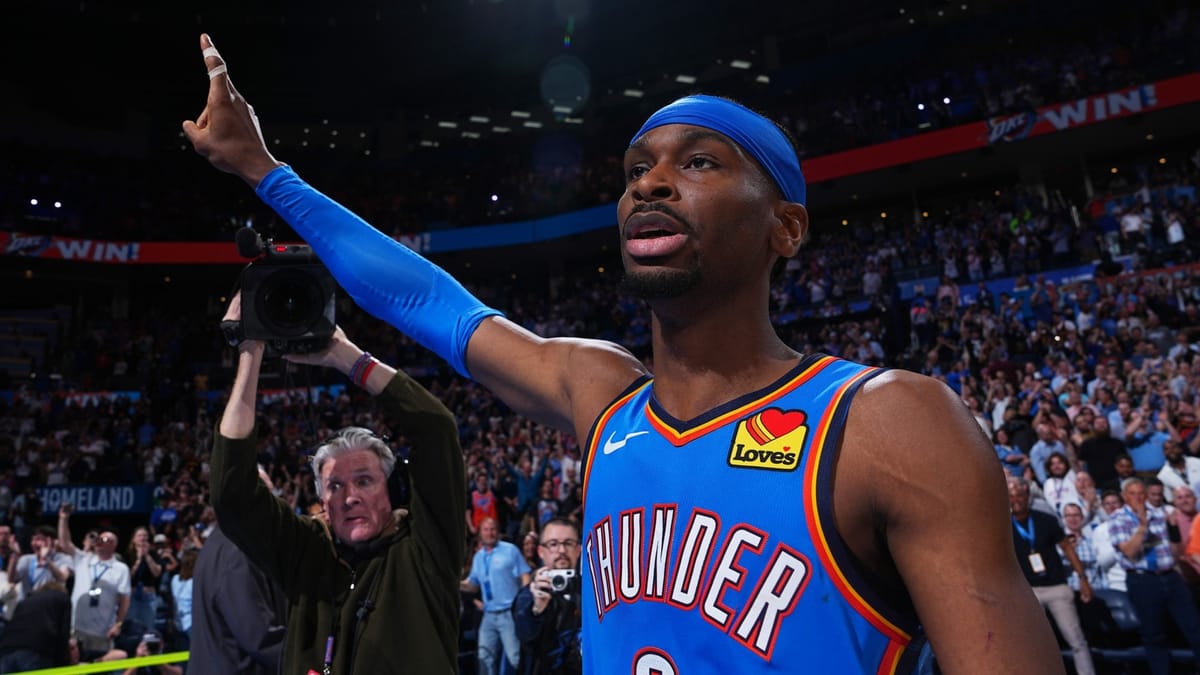
SGA broke Wilt Chamberlain's record on Thursday night, extending his streak to 127 consecutive games with 20+ points—a 62-year-old mark that stood since 1963. Thunder beat the Celtics 104-102; the narrative here isn't just the stat but what it says about modern scoring environments and individual firepower. This is the kind of milestone that reshapes historical comparisons.
The Premier League's weekend slate (Saturday 14 March through Sunday 15 March) features the season's defining matchup: Manchester United v. Aston Villa on Sunday at 10am ET. Man City hosts West Ham on Saturday at 4pm ET; Chelsea v. Newcastle and Arsenal v. Everton bookend the slate Saturday afternoon. Liverpool v. Tottenham on Sunday at 12:30pm ET is the league's second-tier story. These aren't early-season tactical previews—these are late-season positioning battles where every point compounds into European qualification.
NBA play continues with regular-season depth games; no single headline dominates tonight's card, but the postseason picture is clarifying. The Play-In Tournament begins April 14–17.
Culture
Theatrical releases remain light through mid-March. Project Hail Mary (Ryan Gosling, Phil Lord/Christopher Miller directing) opens March 20 and is positioned as the sci-fi flagship of Q1 2026. The film adapts Andy Weir's 2021 novel about a middle school science teacher dispatched on an interstellar suicide mission to stop the sun from dying. This is studio strategy: give awards season space to finish, then launch the year's first unambiguous tentpole sci-fi entry.
The Bride! (Maggie Gyllenhaal, Christian Bale, Jessie Buckley) went wide on March 6 and is already being positioned as the "most controversial" film of 2026—Gyllenhaal's gender-flipped Frankenstein adaptation with political subtext. Box office tracking for the big releases ahead (Project Hail Mary, Ready or Not 2 in April) shows the March theatrical slate will be defined by stragglers and limited releases rather than blockbuster saturation.
Kiki's Delivery Service and Teenage Mutant Ninja Turtles II both return as 2026 re-releases (limited), signaling the perennial nostalgic play that's become a reliable exhibition strategy for mid-tier releases.
Technology
Nvidia is financing infrastructure now, not just selling chips. The company invested $2 billion in Amsterdam-based Nebius yesterday, taking an 8.3% stake and securing a partnership to deploy more than 5 gigawatts of data center capacity by 2030. This is vertical integration at scale: Nvidia isn't just selling H100s anymore—it's securing the ecosystem that buys and deploys them. As one analyst noted, "AI infrastructure is becoming a capital formation story as much as a semiconductor story."
Mind Robotics, spun out of Rivian with CEO RJ Scaringe's backing, closed a $500 million Series A at a $2 billion valuation—the largest robotics round in recent memory. The signal: embodied AI is back in the conversation after a year where generative models dominated capital allocation. Investors see logistics, manufacturing, and service robotics as the next platform opportunity where software meets sensors and real-world deployment.
Oracle is shifting AI infrastructure economics by asking customers to shoulder the upfront cost of expensive chips in new deployments. This reflects the capital pressure created by AI demand—even incumbents are rethinking traditional cloud financing models when hardware bills keep climbing. The old model: providers front capital, rent capacity over time. The new model: customers pay for chips, providers manage deployment. It's a subtle but significant rebalancing of infrastructure risk.
Anthropic's February Series G ($30B at $380B post-money) and OpenAI's February round ($110B at $730B pre-money) have established a new valuation framework: frontier AI companies priced like sovereign digital infrastructure, not software. Both announced enterprise revenue acceleration; Claude Code's ARR hit $2.5B, and Anthropic's enterprise subscriptions quadrupled since January. The frontier AI revenue race is legitimizing valuations that previously looked speculative.
The Uristocrat Store
Everything the Modern Culturalist needs, curated and ready. Shop the latest drops at The Uristocrat Store—from apparel to accessories built for the culture.


Comments