

The dominant narrative around AI and employment is about job losses — what gets automated, what disappears. But a parallel story is developing in real time: a wave of new job titles that didn't exist two or three years ago, all built around working with AI rather than being replaced by it.
Companies are now hiring for roles like Context Engineer, Memory Engineer, Trust Engineer, and AI Reliability Engineer. These aren't marketing titles. They represent genuine technical and operational functions that emerge when an organization tries to run AI at production scale.
The New Roles
A Context Engineer designs the systems that feed AI the right background information, grounding models in relevant data so they don't hallucinate or misfire. A Memory Engineer manages AI long-term memory and user preference continuity across sessions. A Trust Engineer integrates ethical guidelines, explainability, and bias checks into the AI development pipeline — a role driven by the fact that only about 32% of Americans currently say they trust AI.
At the executive level, companies are creating Chief AI Revenue Officers (CAIROs), a role focused on maximizing business value from AI transformation, and Directors of AI Governance and Risk. The AI Reliability Engineer (or AI SRE) monitors model performance, sets anomaly alerts, and responds to AI incidents in production. This role is particularly critical in healthcare, finance, and autonomous vehicles, where AI failures carry real consequences.
What They Pay
The compensation reflects the scarcity of people who can actually do this work. AI Engineer roles have grown by over 143% and now average $206,000 annually — up roughly $50,000 from the prior year. Prompt Engineers command $110,000 to $200,000 or more. AI Ethics Officers land between $120,000 and $170,000. Even Data Trainers, the people who label and refine training data, earn $80,000 to $115,000.
About 90% of CIOs and CTOs report that their organizations have created new AI-specific positions in the past year.
The Bigger Picture
This isn't a rebuttal of AI displacement concerns — those are real and the data on job losses in some sectors is also real. But the labor market response to AI is more complex than "AI takes jobs." New categories of human expertise are forming around AI infrastructure, governance, and reliability. The people who understand how to make AI systems trustworthy, auditable, and performant at scale are in high demand — and the market is paying accordingly.
The question isn't whether AI creates new jobs. It does. The question is whether enough people can develop the skills fast enough to fill them.
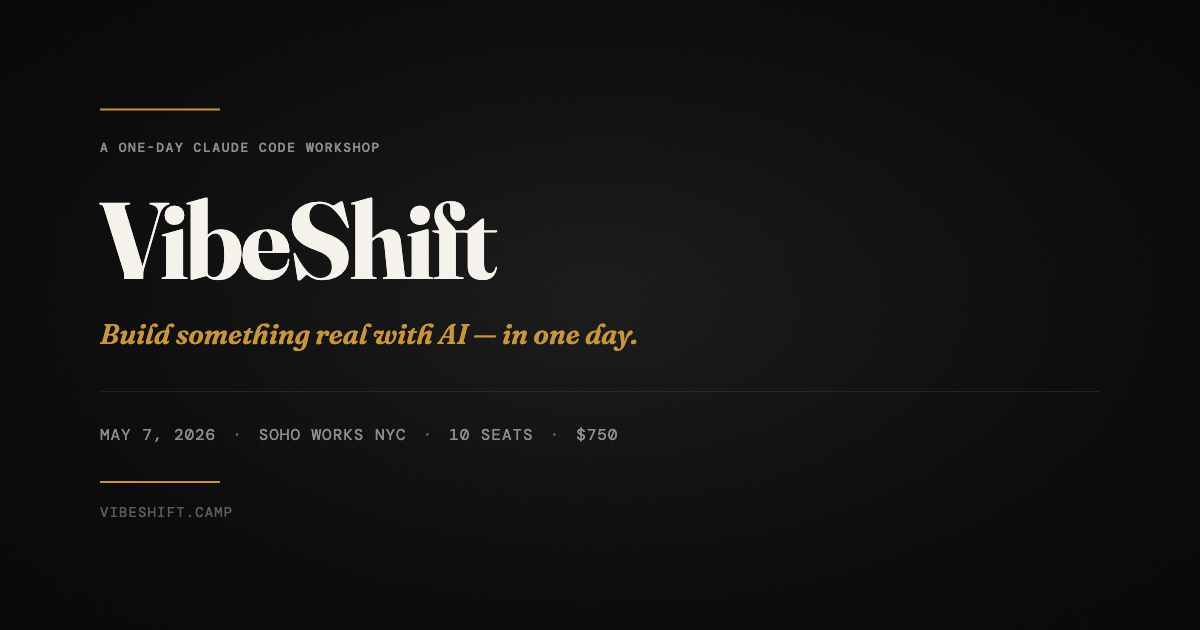
Uristocrat is sponsoring VibeShift
Learn to vibe code — and leave with something you'll actually use at work.
VibeShift is a one-day, hands-on workshop where ten professionals learn to build with Claude Code — using their own real work problems as the material. Run by people who ship AI products for a living. You'll leave with something that works and the know-how to keep going.





Comments