
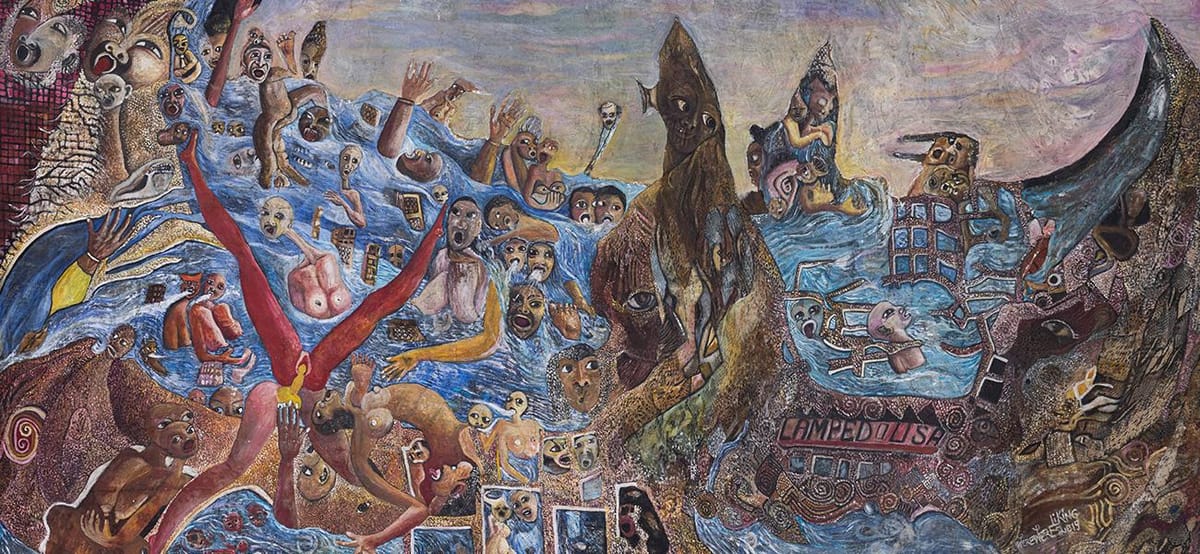
The 61st Venice Biennale opened to the public on Saturday, May 9, 2026, under the title "In Minor Keys" — curated posthumously by Koyo Kouoh, the Swiss-Cameroonian curator who died unexpectedly in May 2025 before the show could be installed. It is the first Biennale to open without a jury in living memory, the first to have 81 of its competing artists withdraw, and the first in years where the most-photographed work is a set of portable toilets.
What happened to the jury
On April 30, all five members of the international jury — led by Brazilian curator Solange Farkas — announced their joint resignation, ten days before the public opening. Their stated reason: the Biennale's leadership had sent legal warnings to the artist representing the Israeli Pavilion, framing protest activity at the pavilion as discrimination and antisemitism. The jurors read that intervention as institutional interference in their independent judgment and walked.
The Biennale's response was to abandon the juried Golden Lion prize for this edition and replace it with a Eurovision-style audience vote — a structural concession that effectively writes off the prize as a critical signal. In its place is a popularity contest. Whatever the audience picks will travel under the same prestige label as past Golden Lion winners, but the institution that confers the prestige spent the spring telling everyone it could not be trusted to confer it.
The strike at the pavilions
On Friday, May 8 — the day before the public opening — artists at the Austrian, Japanese, South Korean, French, Belgian, Dutch, and Egyptian pavilions struck in protest of Israel's continued participation. Pavilions closed for the day. The Art Not Genocide Alliance demonstrated at the Israeli Pavilion itself; Pussy Riot demonstrated against Russia (which has been allowed back for this edition after a two-cycle absence). Eighty-one artists withdrew their entries in solidarity with the resigned jurors.
Israel's pavilion was open, defiantly, on opening day. The artwork inside has been roundly described by visiting critics as unremarkable; the news has been about whether the pavilion should exist this year, not what is in it. The same is true of Russia's. The 2026 Biennale is structurally a show about which national containers were allowed to participate, and on what terms — not what is being shown inside them.
What is actually in the show
"In Minor Keys" is, by general consensus of the early reviews, a Biennale of mourning. The strongest individual works deal with slavery, genocide, and the legacies of mineral extraction in the global south. Qatar unveiled the first newly built Giardini pavilion in decades, an architectural set-piece that immediately became one of the most-visited stops. The Austrian pavilion's "Seaworld Venice" by choreographer Florentina Holzinger turned its space (and its portable bathrooms) into a satirical performance about water, bodies, and access. The Japanese pavilion — Ei Arakawa-Nash's "Grass Babies, Moon Babies" — hung 208 baby dolls in shades and onesies from ropes across a quiet room, scored with baby coos. It is the breakout work of the opening week by visitor count.
The Art Newspaper rates the show three-and-a-half stars and calls it "in minor keys" almost literally — quiet, formally restrained, more elegiac than confrontational. The early Artnet read is harsher: "a protest conducted with fine-print slogans and no concrete demands." Neither is the kind of consensus that historically gets a Biennale remembered for the art.
How this changes the institution
Big international biennials run on the legitimacy of their juries. Strip the jury, and what is left is real estate — pavilions and floor space — without the editorial vote that turned a show into a year-defining career moment for the artists inside. The 2026 Met Gala spent the spring arguing that fashion belongs to art-history institutions; Venice spent the same week showing what happens when those institutions choose self-preservation over critical authority. One is an attempt to elevate. The other is an unforced demotion.
The Biennale runs through November. Whether it will be the last edition under its current governance is the question already circulating in Giardini hallways. If the next Biennale's structure is announced before the end of this one, that will be the actual review.




Comments