
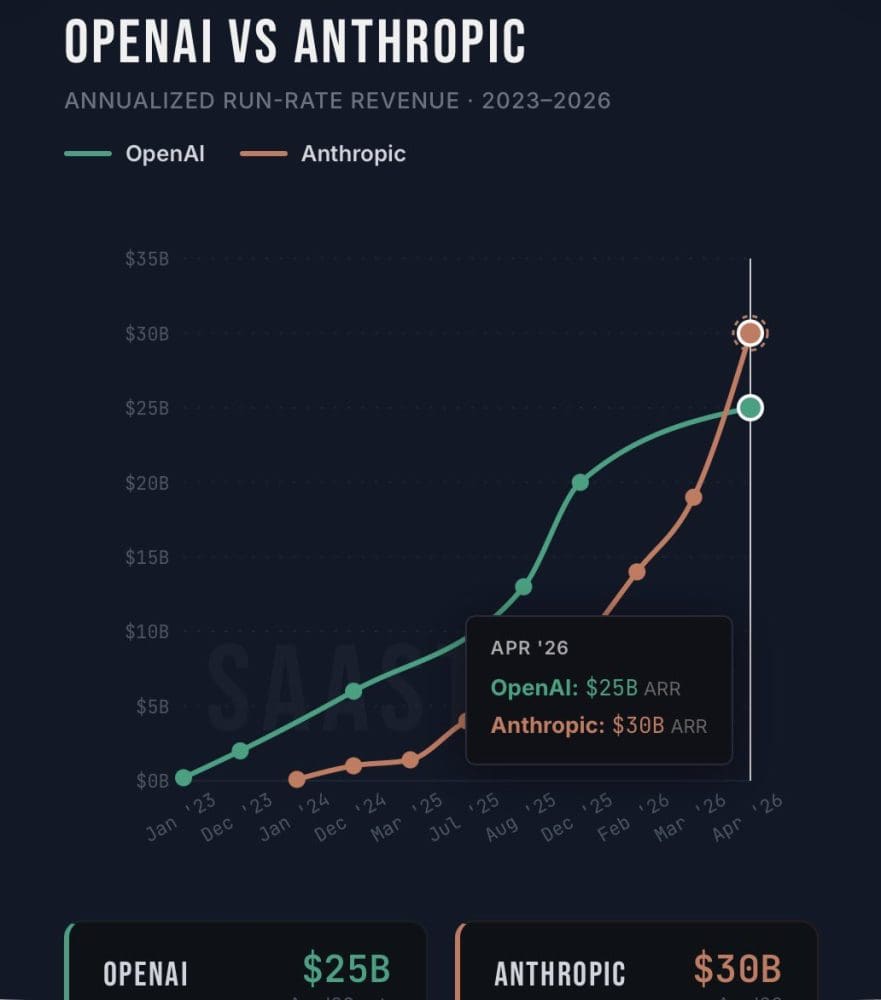
Anthropic announced on May 6, 2026 that it will take over the entire capacity of Colossus 1, the Memphis data center now owned by SpaceX after its February acquisition of xAI. The deal gives Anthropic 300 megawatts of compute and roughly 220,000 NVIDIA GPUs within the month, including H100, H200, and GB200 accelerators. The capacity comes online almost immediately. Paid Claude users felt it first: Anthropic, which just crossed a $30 billion annualized revenue run-rate in April, said the deal directly funds doubled Claude Code rate limits, removal of peak-hour throttling for Pro and Max subscribers, and a sharp increase in Opus API request volume.
The Irony
Elon Musk has spent two years publicly attacking Anthropic. He has called the company "misanthropic and evil," lobbied for federal investigations, and positioned xAI as the explicit competitor to Claude. When SpaceX absorbed xAI in February 2026 — folding $17.5 billion of xAI debt onto SpaceX's balance sheet ahead of SpaceX's $1.75 trillion IPO filing — it inherited two of the largest AI data centers ever built: Colossus 1 in Memphis, and the much larger Colossus 2 still ramping up. That same absorption converted xAI's investors into SpaceX shareholders, and Nvidia later disclosed roughly 122.8 million SpaceX Class A shares worth about $21 billion — meaning the GPU supplier behind Colossus 1 now owns a piece of its landlord.
Musk's quote on the Anthropic deal: "No one set off my evil detector." That is the entire public commentary from the SpaceX side. xAI keeps Colossus 2 for its own training runs. Anthropic gets all of Colossus 1.
Why Anthropic Needed This
Anthropic's revenue grew 80x in a single quarter — from $14 billion ARR in February to $30 billion in April. Compute supply did not grow 80x in the same window. Customers hit rate limits. Coding workloads, which now drive the majority of enterprise Claude consumption through Cursor, GitHub Copilot's agentic features, and the Claude Code subscription, are the most compute-intensive use case in the API. Anthropic ran out of room.
Renting Colossus 1 is the fastest path to 300MW Anthropic could have taken. Building it would take 18-plus months and require permitting. Memphis already had the grid hookup, the racks, the cooling, and the GPUs installed. SpaceX had the spare capacity because xAI had built Colossus 2 specifically to absorb its next-generation training. Both sides solved a problem.
The Orbital Detail
The deal also includes one strange sentence in the press release: Anthropic "expressed interest" in working with SpaceX to develop multiple gigawatts of compute capacity in space. Orbital data centers solve two problems at once — limitless solar power and natural radiative cooling — and SpaceX is the only company with the launch capacity to actually deploy one at scale. Whether either side intends to pursue this in the next 24 months is unclear. That Anthropic put it in writing is itself a signal.
What Changed
The narrative on AI compute for two years has been that infrastructure access defines who wins. OpenAI had Microsoft. Google had its own TPUs. Anthropic had Amazon Trainium, Google Cloud TPUs, and a smaller dedicated GPU fleet. The Colossus 1 deal closes that gap in a single transaction — and it does so via the most ideologically loaded data center in AI. Capital structure beat narrative. Both companies needed something. The transaction happened in 72 hours.
The rest of the AI infrastructure race now plays out on harder ground. Anyone still waiting for the "right" data center partner can watch what just happened in Memphis and decide whether ideology is worth the rate limit.
Source: CNBC · Tom's Hardware · xAI


Comments