
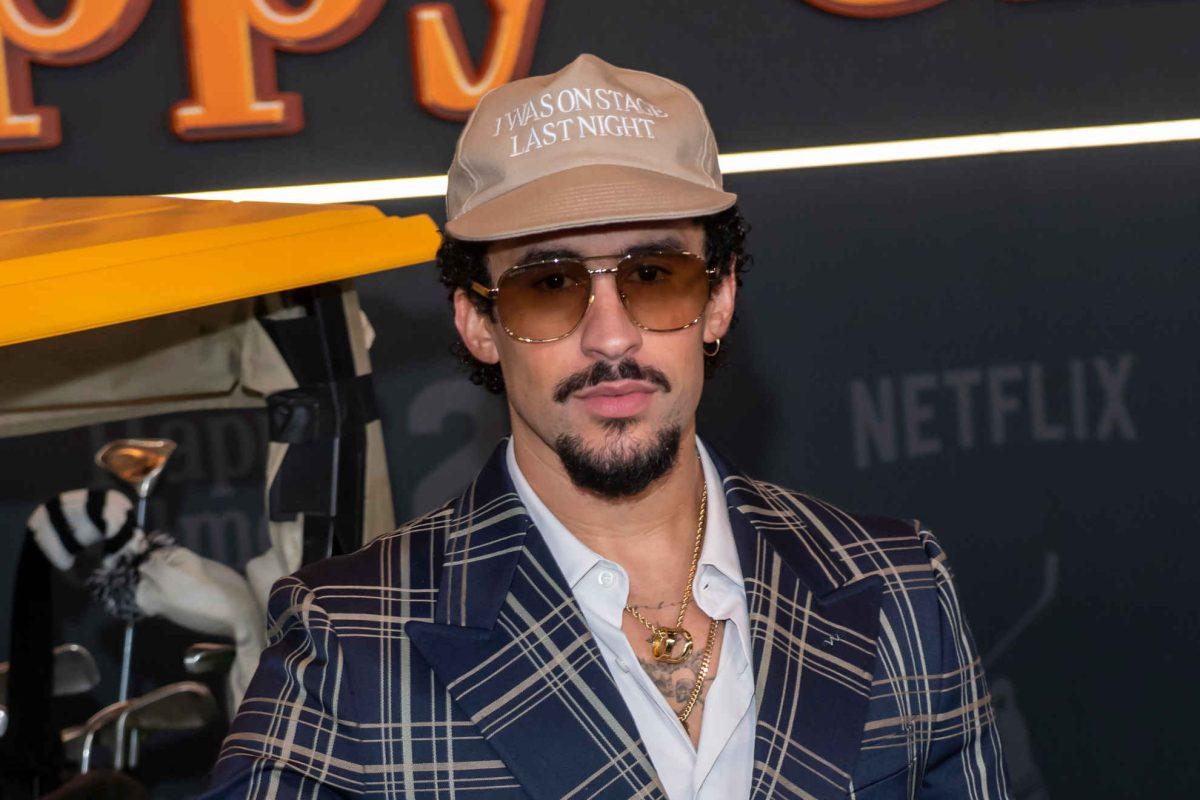
The most quoted look at the 2026 Met Gala wasn't a dress. It was a face. Bad Bunny arrived at the Costume Art exhibition with hyper-realistic facial prosthetics, gray hair, a hunched posture, and a cane — aged roughly 53 years past his actual 32. The prosthetics were applied by Mike Marino, the makeup artist who has aged Robert De Niro for Scorsese and worked on every recent Marvel transformation worth talking about. The suit was a custom double-breasted jacket and straight trousers, designed by Bad Bunny and produced in collaboration with Zara.
The costume wasn't a bit. It was a tribute.
Who Bad Bunny was actually dressed as
The reference was Johnny Pacheco, the Dominican-born flutist, bandleader, and co-founder of Fania Records — the label that built salsa as a global commercial genre out of New York in the 1970s. Pacheco died in 2021. He's the producer and arranger behind the Fania All-Stars sound that made salsa a New York Latino identity statement, then a global one. If you've heard Hector Lavoe, Celia Cruz, Willie Colón, Rubén Blades, or Cheo Feliciano on a record, you've heard Pacheco's directorial fingerprints.
That genealogy is what the Met Gala costume was actually about. The 2026 theme — "Costume Art" — paired with the Costume Institute's "The Aging Body" sub-exhibit, asked guests to interpret what cultural elders look like and whose elders count as art-historical. Most of the carpet read that prompt as either a sculptural exercise or a literal-art-on-fabric exercise. Bad Bunny read it as a question about lineage. Then he answered it by becoming his.
Why this matters more than the carpet moment
Latin music's relationship with American institutional culture has always been transactional. Latin artists win Grammys when they cross over into English. They get magazine covers when they collaborate with Anglo stars. They're invited to events like the Met Gala as guests, not as subjects of the costume institute's serious archival attention. The costume institute itself has dedicated retrospectives to McQueen, Galliano, Comme des Garçons, Dior, and Chanel. It has not dedicated one to a Latin music or fashion lineage.
Bad Bunny's costume essentially staged what that retrospective would look like. He didn't show up as Bad Bunny, which is the default move for any artist trying to maximize personal mythology on a platform like the Met carpet. He showed up as someone the institution hasn't archived yet — Pacheco — and forced the lens onto a Latin music figure who, by any reasonable cultural-history standard, deserves one of those retrospectives.
That's the move. The prosthetics were the medium. The argument is that Latin music has elders, and that those elders are art history, and that the Costume Institute is overdue.
The broader Latin presence
Bad Bunny wasn't the only Latin artist making the case. Rauw Alejandro and Maluma both used their carpet appearances to lean into specifically Latin aesthetic references rather than the European-couture defaults that usually define Met fashion vocabulary. Bad Bunny's extended interaction with Kris Jenner on the carpet — a long, warm hug that went viral — became its own subplot, but the costume itself is the substantive story.
The numbers from the night made the cultural argument harder to dismiss. The gala raised a record $42 million, with Bad Bunny among the most-photographed and most-discussed guests, on a carpet co-chaired by Beyoncé, Anna Wintour, Nicole Kidman, and Venus Williams. Latin artists weren't peripheral to the event. They were central to its commercial output.
The follow-on read
Costume institutes archive cultural artifacts. The Met's Costume Institute has 33,000 objects in its permanent collection. The new Condé Nast Galleries — opening with this exhibition — will hold many of them. The decision about what enters that collection is, ultimately, a decision about what counts as the cultural record.
Bad Bunny's gambit on Monday night was to make a 32-year-old Puerto Rican reggaetonero stand in, for one carpet, as a 70-something Dominican salsa producer who built one of the most consequential Latin music institutions of the twentieth century. The implicit ask: if Bad Bunny is willing to physically embody Pacheco to honor him, then the Costume Institute should be willing to mount the retrospective to canonize him.
That's an argument the Met now has to answer. The carpet was the brief.




Comments