
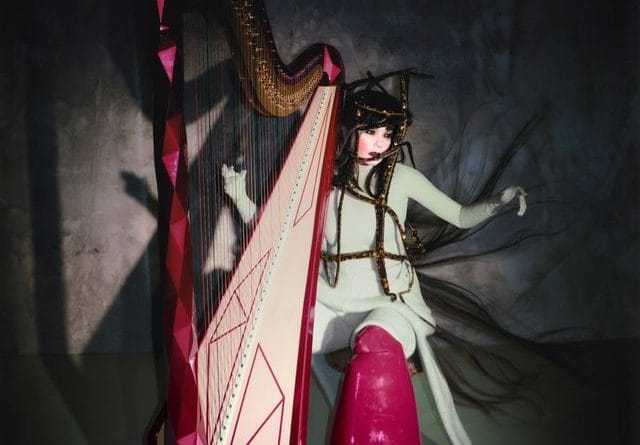
On May 30, the National Gallery of Iceland opens an exhibition called Echolalia — three large-scale installations from Björk, including a brand-new work pulled from her forthcoming album. It runs through September 20. The album itself — her first in four years, since 2022's Fossora — does not have a streaming release date attached. The album is the exhibition. The exhibition is the album.
That decision is the whole story.
What Echolalia Actually Is
The show centers on three works. Ancestress, a film already familiar to Björk listeners, stages a procession in a remote Icelandic valley with the artist accompanied by her son Sindri Eldon. Sorrowful Soil, the most ambitious piece, is a 9-part choral requiem for Björk's late mother Hildur Rúna Hauksdóttir, performed by the Hamrahlíð Choir. The video — egg-shaped, projected — was filmed at the site of the erupting Fagradalsfjall volcano. Thirty speakers are arrayed through the gallery, each transmitting a single voice from the choir, so that walking through the room recomposes the polyphony bodily, in real time, depending on where you stand.
The third installation, unnamed in the festival listing, is the new one. The opening gallery contains "a new installation built around music from Björk's forthcoming album." That is the album drop. There is no Spotify pre-save link. There is no TikTok rollout. The way you encounter the music is by booking a flight to Reykjavík, walking into the National Gallery, and listening.
The Title Is the Argument
"Echolalia" is the clinical term for the involuntary repetition of speech in early child language acquisition — the stage where a toddler echoes back what they've heard before they can produce original sentences. Björk's interpretation is more layered: cultural transmission, ritual repetition, the resonance of voices across generations. The exhibition is, in part, a memorial to her mother. The choir is a literal multiplication of voice. The volcano is the planet's own voice — geological time speaking on its own schedule.
You could call this an art project. You could also call it a release format. Björk has been moving toward this for two decades — Biophilia in 2011 was an iPad app suite, Vulnicura had a VR component, Cornucopia was a touring stage spectacle. Echolalia is the logical end point: a release where the format and the work are inseparable, and where the streaming-single economy is simply not invited to participate.
Why This Matters in 2026
The mainstream music industry just spent five years building the playlist economy: short songs, fast hooks, algorithmic placement, Friday drops. The exit ramps are visible everywhere. Beyoncé and Taylor Swift built their last era cycles around physical-product theatrics — vinyl variants, surprise album drops, theatrical concert films — that recover album-as-event from algorithm-as-event. Frank Ocean still won't tell anyone what he's doing. Kendrick dropped GNX with no preamble.
Björk's move is more extreme than any of those. She is releasing a new album as a museum exhibition with a closing date. If you don't go to Iceland between May 30 and September 20, you will miss the experience the artist designed. The audio will eventually be released on streaming — there's no way it won't be — but the artist has unambiguously declared which version is the canonical one.
That's a position statement. The streaming version is the bootleg. The exhibition is the work.
The Companion
Sharing the gallery is Metamorphlings, the first museum retrospective of James Merry, Björk's longtime visual collaborator. Roughly 80 of Merry's masks — embroidered, 3D-printed, silversmithed — pulled from Celtic imagery, ancient ritual, and natural form. Several were designed for Björk; others for Tilda Swinton and Iris van Herpen. The retrospective treats Merry not as a stylist or a sidekick but as the artistic peer he has always been.
The double-billing is a thesis: music does not happen in isolation; it happens in collaboration, in objects, in space, and across time. Echolalia is the proof.
The Reykjavík Arts Festival closing date — September 20, 2026 — coincides with a total solar eclipse over Iceland. Of course it does.
Related on Uristocrat: more music coverage.


Comments