
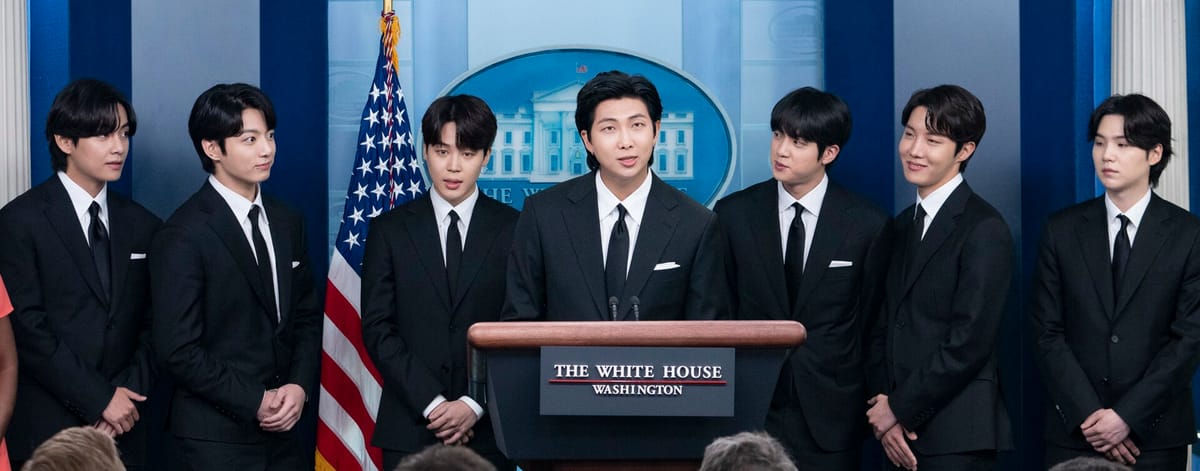
When BTS returned to the stage on April 9 for the opening night of their ARIRANG World Tour, they were wearing Korean armor. Not literally — but almost. Designer Jay Songzio built their comeback costumes around a concept he called "Lyrical Armor": the toughness of traditional Joseon-era protective wear, filtered through the sorrow and longing of han, the Korean emotional concept that runs through the album's namesake folk song. The result was something that looked like fashion but functioned as argument.
The argument: Korean heritage is not a reference point. It is the point.
What Songzio Built
Each member of BTS received a specific archetype drawn from Korean cultural history. RM became the Hero. Jin, the Artist. Suga, the Architect. Jimin, the Poet. Jungkook, the Vanguard. J-Hope embodied the sorikkun — the singer of pansori, a traditional Korean musical storytelling form. V took the role of the seonbi, the refined Korean gentleman.
The costumes followed. A monochromatic palette across layered construction — some pieces built from five separate layers. Custom distressed handwoven fabric in cotton and linen with cascading threads. Studs, black onyx, metallic jewelry-like ornamentation. Jungkook's distressed white shirt carried Korean landscape painting across its surface. The asymmetrical looks for background dancers used contrasting linen white and red to extend the visual language beyond the main stage.
Songzio described the collection's keyword as "singing armor" — protection that carries emotion, structure that carries story. It's a phrase worth sitting with. The design didn't decorate the performance. It narrated it.
Why "Arirang"
The choice of album and tour title was never incidental. Arirang is a traditional Korean folk song that predates any of the members by centuries — a melody with dozens of regional variations, all built around themes of separation, longing, and the kind of hope that has already survived a great deal. During the Japanese occupation of Korea, when Korean language and cultural expression were actively suppressed, Arirang became a form of cultural resistance. People sang it when they couldn't say what they meant.
BTS naming their reunion album after that song — their first major release after completing mandatory military service — is not a casual decision. It's a declaration about what the comeback means and where it's rooted. Not in Western validation. Not in global pop formula. In a folk song that survived an occupation.
Fashion as Argument
BTS has been a fashion force for years. The numbers are real — 56 billion won in media value generated across 2026 Spring/Summer fashion weeks in New York, Milan, and Paris. Every major luxury house has competed for their proximity. They've worn Saint Laurent, Valentino, Dior. The Western fashion system has, for years, offered its platform to legitimize their global relevance.
With ARIRANG, they reversed the flow. Songzio is a Korean designer. The references are Korean. The archetypes are Korean. The emotional framework — han, the folk song, the Joseon-era armor — is Korean. This is not K-pop borrowing Western fashion's authority. This is Korean heritage being positioned as the authoritative foundation upon which the rest gets built.
That shift matters beyond BTS fandom. When the most-watched comeback performance of the year centers Korean tradition not as aesthetic but as argument, it changes what the global fashion conversation has to respond to. The tour has 85-plus dates in 34 cities. The costume is going everywhere the music goes.
What Songzio made for that opening night wasn't a wardrobe. It was a thesis.



Comments