
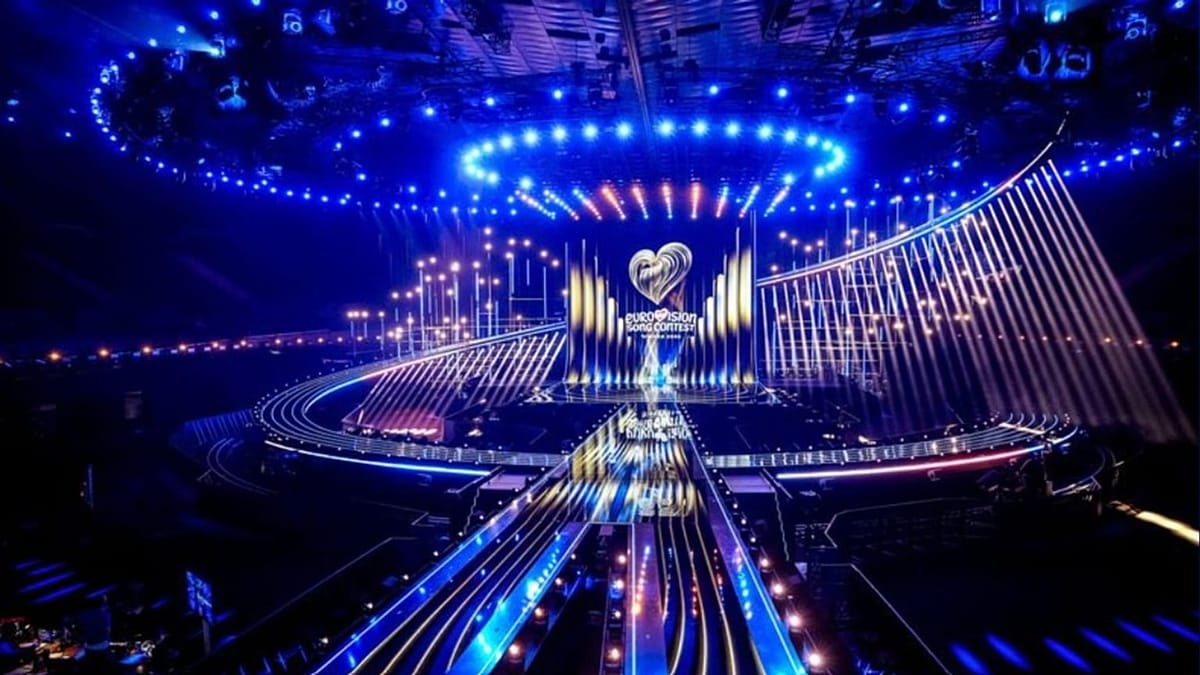
The 70th Eurovision Song Contest opens tonight at 21:00 CEST from the Wiener Stadthalle in Vienna. Fifteen countries perform; ten advance to Saturday's Grand Final on May 16. Victoria Swarovski and Michael Ostrowski host. Germany and Italy — two of the Big Five with automatic Grand Final berths — will perform their entries during the show but cannot be eliminated.
The lineup
The Semi-Final 1 running order: Moldova, Sweden, Croatia, Greece, Portugal, Georgia, Finland, Montenegro, Estonia, Israel, Belgium, Lithuania, San Marino, Poland, and Serbia. The bookmaker favorites going in are Finland (Linda Lampenius and Pete Parkkonen's Liekinheitin), Greece (Akylas's Ferto), Sweden (Felicia's My System), Israel (Noam Bettan's Michelle), and Moldova (Satoshi's Viva, Moldova). Croatia, Serbia, Lithuania, Montenegro, and Poland are all in striking distance of the remaining qualifying spots.
The political weight
Israel's participation is the contest's loudest external story. Five countries are boycotting the 2026 edition over its inclusion during the war in Gaza, and the build-up has been dominated by the question of whether the European Broadcasting Union should have followed UEFA's lead in suspending Israeli participation. The EBU's answer was no. The voting math has produced its own answer in the last two contests — Israel finished second in 2024 and 2025 on the strength of a public televote that consistently outpaced jury rankings, which a number of European broadcasters publicly attributed to coordinated voting from outside the participating countries.
The EBU's response this year is structural: maximum public votes per person have been cut from 20 to 10. That is the single largest mechanical change to the voting system in more than a decade, and it is aimed squarely at the kind of organized 20-vote campaigns that lifted Israel and a handful of other entries up the leaderboard. Whether it actually flattens the effect is one of the most-watched analytical questions in the contest's history.
What Vienna means for the format
This is Eurovision's third time in Vienna, after 1967 and 2015. The Wiener Stadthalle hosted the 2015 edition that immediately followed Conchita Wurst's 2014 win — the contest's first true viral-moment year and the one that proved Eurovision had become a cultural property that could move beyond Europe's borders. The 2026 edition has consciously leaned on that legacy: a 70th-anniversary opening act featuring past Austrian and Swiss winners, the Turquoise Carpet event at the Burgtheater on May 10, and an explicit programming through-line about the contest's history as a stage for queer, immigrant, and minority artists.
That argument about Eurovision-as-living-archive is the same one Cannes is making 1,500 kilometers south, where the festival is using its own pre-opening night on May 12 to screen the 4K restoration of Pan's Labyrinth twenty years after the film's record-setting standing ovation. Two of Europe's biggest cultural events open the same night with the same pitch: continuity matters; the history is the value.
What to watch for
Three numbers to track tonight. First, the qualifier-to-favorite alignment — if the bookmaker top five all advance, the voting reforms are working as intended. Second, Israel's televote share. Third, viewership: the 2015 Vienna contest pulled 197 million live viewers, and a slip back toward 150 million would be a real sign that the political controversies are costing the contest its global audience.
Semi-Final 2 follows on Thursday, May 14. Grand Final, Saturday, May 16, 21:00 CEST. Twenty-six countries on stage. One winner.

Comments