
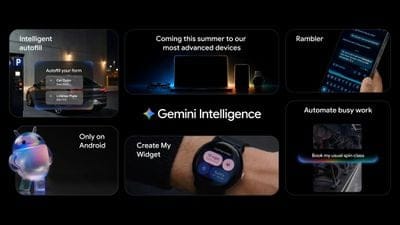
Google previewed Android 17 on Tuesday, May 12, branding its consumer AI suite "Gemini Intelligence" in a clear echo of Apple Intelligence. The reveal landed roughly four weeks ahead of Apple's WWDC 2026 keynote on June 8, where the company is expected to introduce iOS 27 and a Gemini-powered Siri rebuild. The timing is the entire story.
What Got Announced
"Gemini Intelligence" packages a set of agentic features that go beyond the assistant-style interactions Google was demoing a year ago. The headline capabilities:
- Autonomous task execution: Gemini can now book reservations, make purchases, and complete multi-step actions across third-party apps — expanding from the limited rideshare/food-delivery test Google ran earlier this year with Samsung and Pixel users.
- Visual context awareness: Gemini reads what's on screen and acts on it — building a shopping cart from a grocery list in a notes app, for example.
- Rambler: a voice dictation tool that strips filler words ("um," "ah," "like") and switches between languages mid-sentence.
- Create My Widget: natural-language widget generation.
- Platform expansion: Gemini in Android Auto, Google-built-in cars, wearables, and laptops — with full automotive integration and Zoom meeting access from the dashboard.
Google also previewed a refreshed Android Auto with 3D navigation and a "Pause Point" feature that limits app distraction with breathing exercises. The broader rollout begins this summer on Samsung Galaxy and Pixel phones, expanding to wearables, cars, glasses, and laptops by year-end.
Why the Timing Matters
Apple's WWDC keynote is set for June 8. The Gemini-powered Siri rebuild — which Apple confirmed in March after a deal with Google — is the centerpiece consumer-AI story Apple has to tell this year. Google has now spent a month getting in front of that narrative.
The strategy is straightforward: define Gemini as the AI layer across phones, cars, and laptops before Apple defines Gemini as the engine inside Siri. If Apple's WWDC pitch is "Siri got smart because of Google," Google wants the prior thirty days of headlines to read "Gemini is everywhere, including inside the next iPhone." That positions the same partnership as Google's deal-makes-Apple-relevant story, not Apple's catching-up story.
The Agentic Gap
The autonomous task execution piece is the meaningful one. Most consumer AI right now is still chat — you ask, it responds. The category shift toward AI that acts — books the table, completes the purchase, fills the cart — is the bridge between assistant and agent. Google is now publicly past it. Apple is not yet there.
That's a meaningful capability gap for the next three months. Apple's Liquid Glass design pivot was the company's last major OS-level reveal, and the AI story trailed it — Apple Intelligence shipped as writing tools, notification summaries, and Image Playground, features rather than agents. WWDC 2026 has to close that gap or admit it. Google is making the gap visible in advance.
The Partnership Tells
The Android 17 reveal also surfaced a partnership with Meta: Instagram photo and video quality improvements that Google says will appease creators frequently posting to the platform. Meta and Google publicly aligning on creator workflow is a relatively new posture — and it lands the same week Apple is reportedly siding with Google to fight European AI competition measures.
The competitive picture has tightened into a clearer alignment: Google, Apple, and Meta now share more interests than they have in a decade, with OpenAI as the shared external pressure. The "Gemini Intelligence" branding is Google's bet that it can stay at the center of that triangle by being indispensable to all three sides. Holding that center depends on shipping models on schedule, and Google has since slipped: Gemini 3.5 Pro missed its June target with no replacement date announced.


Comments