
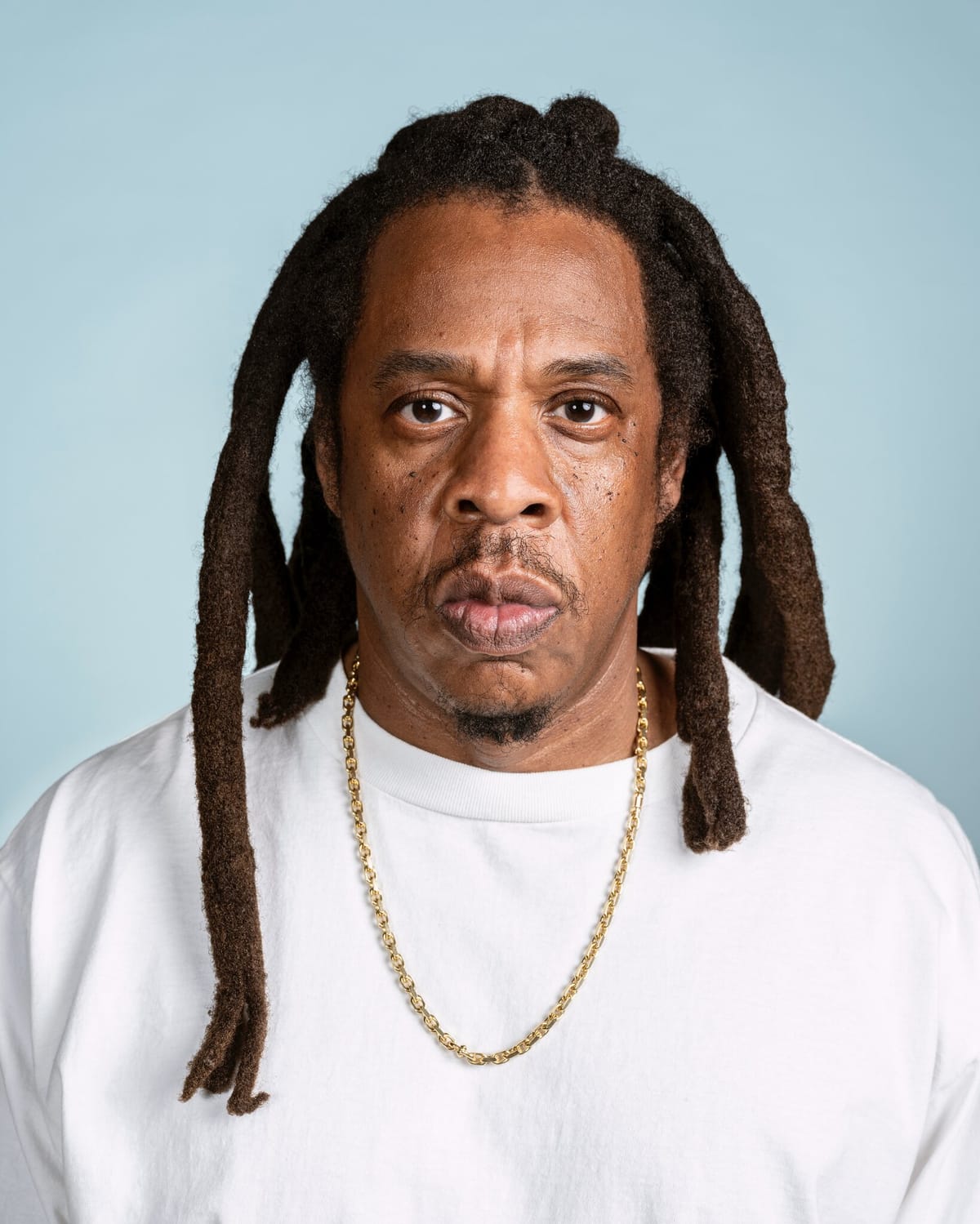
The New York Times Magazine published its inaugural 30 Greatest Living American Songwriters list on Monday, April 27, an unranked canon assembled by 250 music insiders and six Times staffers. Jay-Z made it. So did Kendrick Lamar, Missy Elliott, Young Thug, and OutKast — five hip-hop entries inside a list that also reaches across Bob Dylan, Bruce Springsteen, Stevie Wonder, Dolly Parton, Mariah Carey, Taylor Swift, Bad Bunny, Lana Del Rey, and Fiona Apple. .
The tribute was written by Pusha T. Pusha is the rapper most likely, of any peer in his generation, to take Jay's own writerly seriousness seriously. He has spent two decades collaborating with Hov, three official tracks across "Drug Dealers Anonymous," "So Appalled," and "Neck & Wrist," plus the Clipse cuts that Jay never returned. The Times handing him the pen for the canonization piece is a recognition of that lineage.
Jay-Z, in his own words
The Times piece foregrounds Jay's process. Asked how a verse begins, he said, "Most times I come up with the flow first. I'm trying to work out the pockets, and then I'll fill it in." That's the description of a writer who treats rhythm as the primary text and meaning as the second pass — a reversal of how most songwriters describe their own work, and a cleaner statement than he has given in any prior interview.
On the album he found hardest to write, he picked 4:44. Not because the lyricism was the lift, he said, but because of "the vulnerability, the honesty and transparency. That's hard." Jay-Z has been many things on record over twenty-six years; a man telling the New York Times that confession was harder than craft is a different kind of admission than the one the album already made.
https://twitter.com/iamphella/status/2049229689177158065
Pusha T on Jay-Z's place in the culture
Pusha's tribute opens not on a verse but on a generation. From the piece:
There haven't been many people who can speak for a generation, and speak to the mentality of what Black youth was going through, for everyone who indulged in the allure of street culture. He gave us such a tutorial, his whole career — about street life, drug culture, luxury, the pitfalls as well as the floss. And then he took "Allure," from The Black Album, and basically admitted, Man, I fell victim to the game. It is just the best representation of a rap artist speaking to his demographic, which was a lot of the kids exposed to the crack era from every angle.
Everybody who was playing in that world, you know, we all had moments of clarity. Regardless of whether it was an opportunity in music, a near-death experience of a friend or yourself, a run-in with the law — everybody had this feeling and told themselves, That's it. And the game called them right back. That chorus and bridge really captured the feelings of anyone living that life. And the hook spoke to a level of admission of, like, I know I'm doing wrong. I see clearly. I'm over it. I'm done. But everybody, you know, folded and ran back, like an addict.
He's talking about a real experience, and his mission is to articulate, in the best possible way, his feelings at the time. When you draw from real experience, there's a level of passion that comes across — I've always felt like that was something he did very well. Even his more commercial records, they always still carried a heavy weight of lyricism. "Ni**as in Paris," "Hard Knock Life," "Otis" — these are all hit singles, and his verses carry the weight of mixtape verses.
Pusha frames Jay not as a virtuoso but as a documentarian of a specific cohort. The "weight of mixtape verses" line is the kind of compliment only another writer can land, because only another writer knows the difference.
"Hovi Baby" scared him
The tribute's emotional center is a single track. Pusha picks "Hovi Baby" — the Just Blaze-produced cut from 2002's The Blueprint 2: The Gift & the Curse — and goes full hand-on-the-table:
One of his best performances, to me, is "Hovi Baby." Lyrically it is by far one of the best [expletive]-talking, acrobatic, philosophizing — I mean, come on. Listen: At that point I was scared of Jay-Z. This is another stride of lyricism, philosophy, I'm-the-best braggadocio, bravado. And he's, like, tap-dancing all over this beat. Later on in the song, he starts talking about how he's chasing the snare around — and he's actually doing it. To me, that was a Super Saiyan moment. "Hovi Baby" scared the hell out of me.
Coming from a rapper whose entire brand is unflappable cool, "scared the hell out of me" is the most generous thing Pusha has ever said about another writer. It's also a precise critical observation — Pusha is naming the moment where Jay's flow stopped tracking the beat and started conducting it.
Listen to the second verse with Pusha's frame in mind, the one where Jay raps about "chasing the snare around the track." It's a literal performance of the thesis. The flow doesn't sit on the beat; it stalks it.
Lists like this are usually noise. The Times is doing it now, with this composition, five hip-hop entries, a video interview series, and a peer-written tribute architecture, which is the closest a legacy publication has come to treating contemporary rap as American songwriting at the same critical altitude as Dylan or Springsteen. Jay-Z has been arguing for that altitude for thirty years. Having Pusha T, of all people, write the tribute that lands him there is the version of the story that closes the loop.
For everyone keeping score: this is the same week the Times is shipping its print issue across newsstands in Austin, Atlanta, Los Angeles, Nashville, and New York. Billboard has the full list; Roc Nation is celebrating the placement. We've also written about Jay-Z's Yankee Stadium ticket frenzy and the JAŸ-Z GQ April cover earlier this year.



Comments