
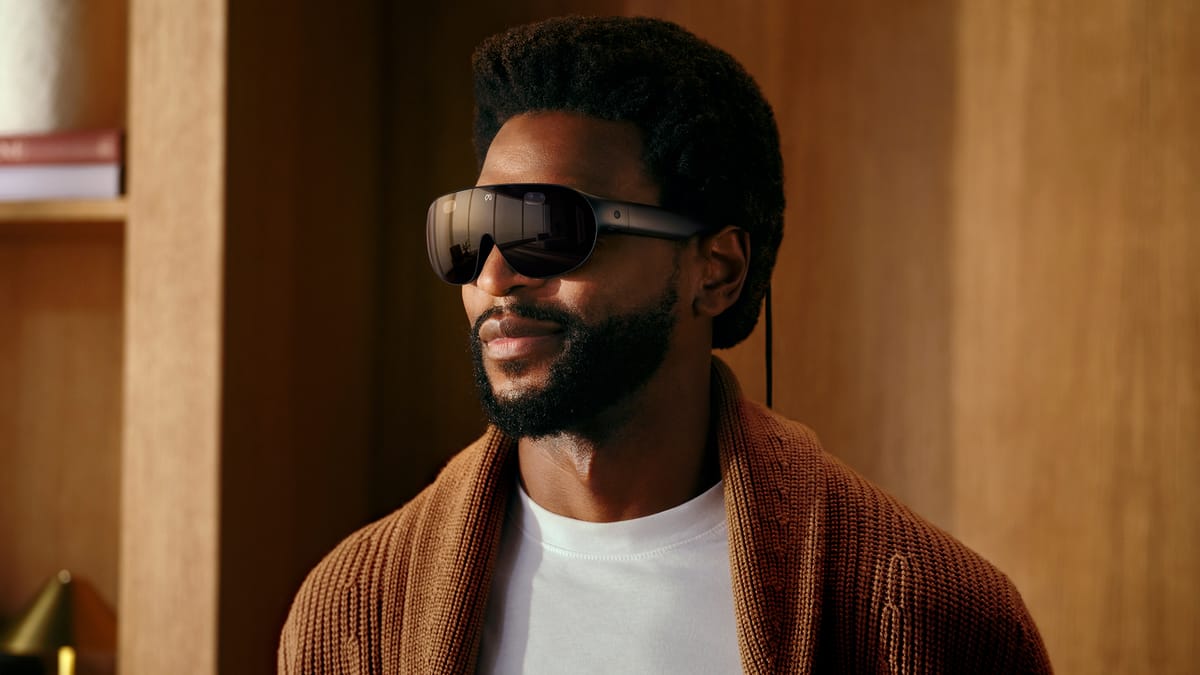
Meta CEO Mark Zuckerberg unveiled Meta VR Glasses, a $1,299.99 virtual reality device that weighs about 100 grams, at the company's Connect 2026 keynote in Menlo Park, California, on Wednesday, September 23. He also introduced Ray-Ban Meta Audio, Meta's first camera-free glasses, and Muse Charm, a handheld device for the company's Muse AI agent. CNBC reports the VR Glasses are Meta's first VR device since the $299 Quest 3S in 2024.
Meta VR Glasses
The glasses use a two-part design. The frames hold the sensors and display, while a puck connected by an optical tether holds the compute, battery, and storage and clips to a pocket or bag. Meta says the system is five times lighter than the Meta Quest 3 headset. The display is a 5K micro-OLED panel at 37 pixels per degree, with Dolby Vision and Dolby Atmos spatial audio. The puck runs Qualcomm's new Snapdragon Reality Elite processor and delivers up to three hours of continuous high-resolution media playback, with 45W fast charging, according to Meta.
Users control the device by voice, eye tracking, and hand gestures, with Meta's AI agent built into the operating system. Meta says it is the first IMAX Enhanced certified VR device. Disney+ will stream Marvel films in 3D in select countries starting in November, and Peacock, HBO Max, and Paramount+ will offer their 3D catalogs for the first time. Meta also plans more than 100 immersive live sports events a year once the glasses launch, with partners including ESPN, MLB, NBC Sports, TNT Sports, and UFC.
More than 75 games will work with hand gestures alone at launch, and Xbox Cloud Gaming streams additional titles. Engadget reports the glasses will run every Quest game with support for Touch Plus controllers. The device also works as a multi-screen workspace, turns any flat surface into a keyboard and touchpad, and supports photorealistic hologram video calls in apps including WhatsApp and Zoom.
Ray-Ban Meta Audio and Gen 3
Ray-Ban Meta Audio, designed with EssilorLuxottica, drops the camera and handles music, podcasts, calls, translation, and the AI assistant. The glasses weigh 43 grams and run up to 12 hours on a charge, with up to 48 more hours from the charging case. They come in two styles, Clubmaster and Burbank, across 23 color and lens combinations, and support prescription lenses. Pre-orders opened September 23 at $349, with shipping on October 13. TechCrunch reports the audio-only design follows criticism of camera-equipped AI glasses being used to record people without consent.
Meta also released Ray-Ban Meta (Gen 3), available now from $449. It adds the Aviator and a cat-eye Zena frame to the Wayfarer, in 27 color and lens combinations. Gen 3 has a 12MP camera with 3K video, up to nine hours of battery, one hour more than Gen 2. A new Meta Adventurer starts at $249, Meta's lowest glasses price yet, and goes on sale October 23. A LISA Edition collection designed with the Blackpink singer starts at $399.
Meta also announced Hearing Enhancement, which tunes the glasses' audio to a hearing test in the app. Zuckerberg called it an FDA-cleared, over-the-counter hearing aid for perceived mild to moderate hearing loss, The Next Web reports. It comes to Meta Glasses in the US later this year, then to Ray-Ban Meta (Gen 3) and Ray-Ban Meta Audio, according to Engadget.
Meta Ray-Ban Display, launched at Connect 2025 at $799, is now available to order online in the US at that price, according to Engadget. It is also on sale in the UK at £749 (about $1,000) and Canada at C$1,149 (about $830), with sales in Germany, France, and Italy starting October 13 at €899 (about $1,050).
Muse Charm and the Muse agent
Zuckerberg closed the keynote with Muse Charm, which The Next Web describes as a keychain device users activate by tapping a fingerprint sensor and speaking. "We packed the whole Muse experience, including the full real-time voice and avatar stack, into something that fits on a keychain," Zuckerberg said. Meta said it still has to finalize the component layout and plans to ship in December. It did not announce a price.
Muse launched in early September and runs on Muse Spark, Meta's multimodal model for agentic work, TechCrunch reports. New features include Muse Realtime Avatar, which lets users video chat with a face-and-voice version of their agent, and wake-word access on Meta's AI glasses "in the coming months." Muse will also operate any app on a Mac, and Meta chief AI officer Alexandr Wang said the agent will soon get its own email address.
For shopping, Muse can buy from Shopify's catalog through Link and Shop Pay, with added PayPal support and a partnership with Stripe. New retail partners include Best Buy, Gap, Sephora, Walmart, and Wayfair, plus Expedia and, soon, Instacart. Work connectors include GitHub, Granola, and Notion. Wang said Meta received more than 1,500 developer applications for its connector platform in under a week. Zuckerberg said Muse is free for "a huge number of tokens" and that Meta expects to profit from a small fee on transactions.
Meta stock gained 11.3% to close at $741.25 on Monday, September 21, adding $192 billion in market value, Yahoo Finance reports, citing investor enthusiasm for Muse.
Uristocrat previously covered the $799 Ray-Ban Display glasses unveiled at Connect 2025, the $299 smart glasses with Muse Spark AI launched in June, and Muse Spark, the first reasoning model from Alexandr Wang's Superintelligence Labs.
Source: Meta, Meta, CNBC, TechCrunch, The Next Web, TechCrunch, Engadget, Yahoo Finance

Comments