
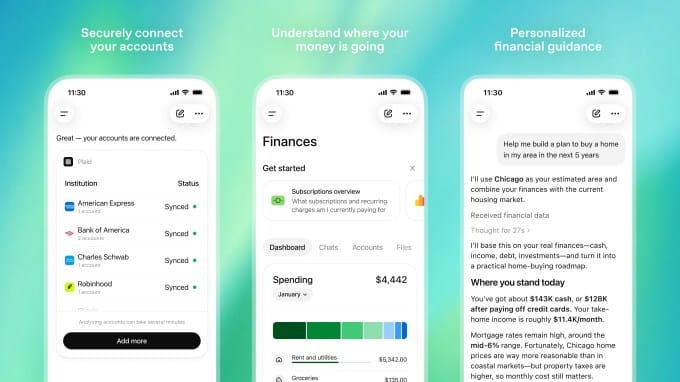
OpenAI has launched a personal finance experience inside ChatGPT, letting users connect their bank, brokerage, and credit accounts and ask questions about their own money. The feature is in preview for ChatGPT Pro subscribers in the US, with Plus and other tiers to follow.
How it works
OpenAI partnered with Plaid — the same account-linking infrastructure behind most fintech apps — to connect more than 12,000 institutions, including Chase, Schwab, Fidelity, Robinhood, American Express, and Capital One. Once linked, ChatGPT shows a dashboard of balances, spending, subscriptions, and upcoming payments, and answers questions grounded in real transaction data: where the money went last month, what a planned purchase does to the budget. The access is read-only — ChatGPT can see balances, transactions, investments, and liabilities, but not full account numbers, and it cannot move money. Support for Intuit is coming, which would let it model scenarios like the tax impact of selling a stock.
The trust ask
This is a real escalation in what OpenAI is asking users to hand over. ChatGPT started as an answer engine; over the past year it has quietly positioned itself as the place that holds your most sensitive context — it acquired a health-records startup, and now it wants your financial life. Each step is individually convenient and collectively enormous: a single model with a connected view of your health and your money is a concentration of personal data with little precedent in a consumer product. The read-only limit and the hidden account numbers are genuine guardrails. Whether they are sufficient ones is a question every Pro user is now answering by clicking "connect."
The same workflow, in Claude
The connected-finance pattern is not OpenAI-exclusive. For readers who would rather run it inside Claude — and keep the data closer to their own hands — Uristocrat's Financial Pulse agents at skills.uristocrat.com recreate the same workflow: link your accounts, get a plain-language read on spending, subscriptions, and upcoming obligations, and ask the model questions against your real numbers. The capability is becoming table stakes. The choice worth making deliberately is whose model, and whose servers, end up holding the picture.



Comments