
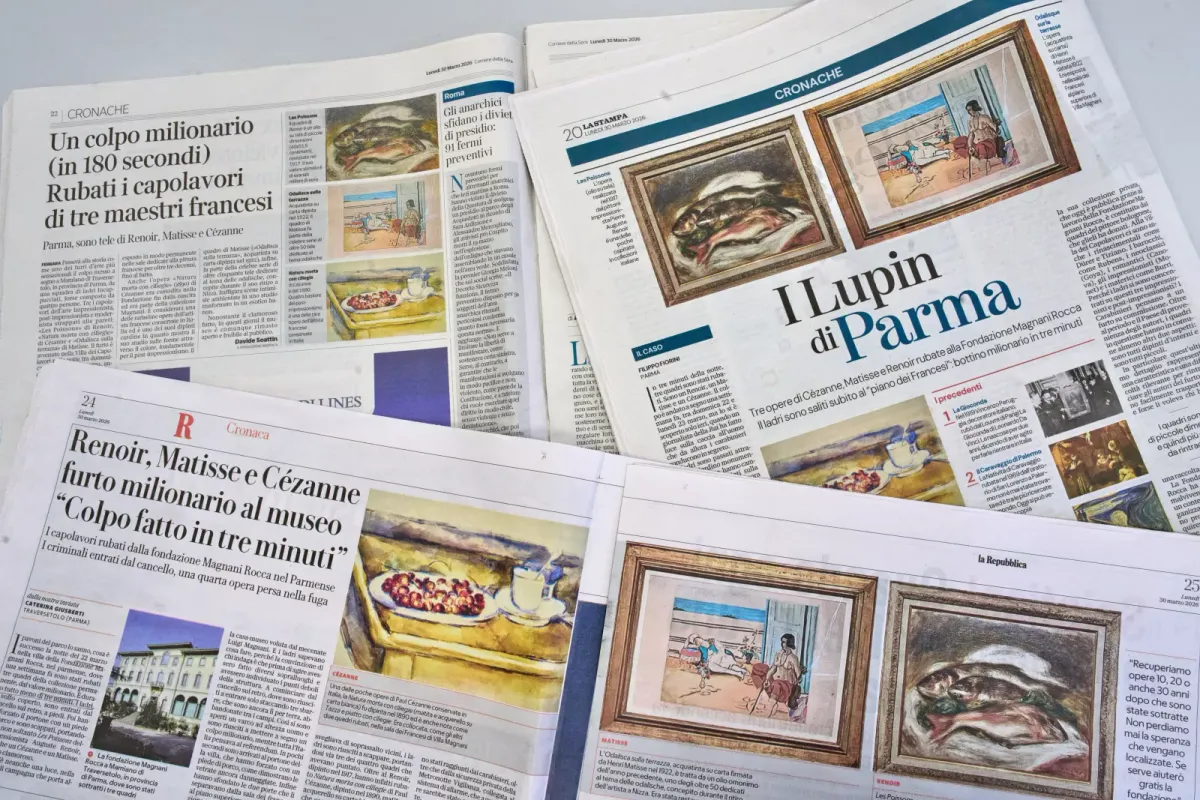
On the night of March 22-23, four hooded thieves broke into the Magnani-Rocca Foundation near Parma, Italy, forced entry through a first-floor door, and stole three paintings in under three minutes. They were gone before police arrived. The museum's alarm triggered during the theft, but it was too late — the thieves fled across the gardens and climbed the fence. The works taken: Renoir's Les Poissons (1917), Cézanne's Tasse et plat de cerises (c. 1890-1904), and Matisse's Odalisque sur la terrasse (1922). Combined estimated value: approximately 9 million euros.
The theft wasn't publicly disclosed until March 30 — a full week later — because the museum and police deliberately kept it quiet, hoping the thieves might return and be caught. They did not return. A lawyer for the foundation described the operation to CNN as "structured and organized," which is consistent with the speed and precision of the execution. The Cultural Heritage Protection Unit of the Carabinieri is leading the investigation, reviewing surveillance footage from the museum and neighboring businesses. No arrests have been made.
Art Recovery International founder Christopher Marinello put it plainly: "Museums need to start thinking about the possibility of the three-minute theft." The Magnani-Rocca heist follows a string of high-profile European museum thefts, most notably the October 2025 Louvre heist in Paris (88 million euros in jewels and items). The proximity in time and the professional execution have raised questions about whether these operations are connected or simply emboldening. The paintings are now in the international database of stolen art. The museum has reopened and continues operating. The walls have gaps.


Comments