
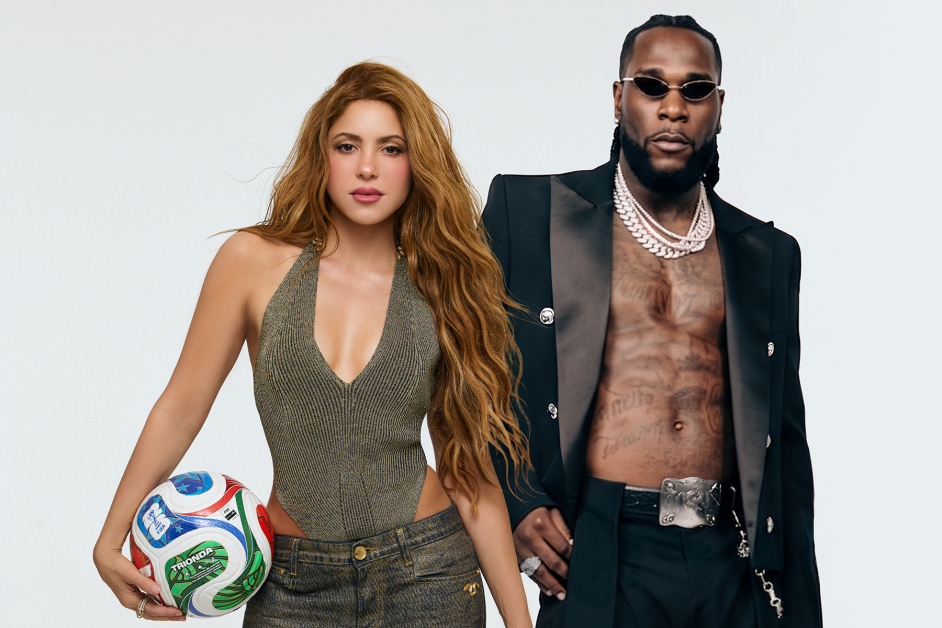
Shakira and Burna Boy released "Dai Dai" on May 14 as the official song of the 2026 FIFA World Cup, hosted across the United States, Canada, and Mexico this summer. The nearly four-minute track blends Afrobeats, dance-pop, world beats, and reggaetón, and its title is Italian for "Let's go." It arrives tied to the FIFA Global Citizen Education Fund — and ahead of a final that will stage the tournament's first-ever halftime show.
A deliberate pairing
The casting is the message. Shakira's "Waka Waka" remains the most-streamed World Cup song ever, the rare tournament anthem that outlived its tournament. Putting her on the 2026 track is FIFA reaching for proven, durable pop. Burna Boy is the other half of the calculation: the artist who carried Afrobeats from a regional sound to a global headlining genre over the last decade.
Together they cover the two markets FIFA most wants for a North American World Cup — the Latin audience that drives soccer viewership across the U.S. and Mexico, and the global youth audience that treats Afrobeats as default pop. The lyrics reinforce it, name-checking Maradona, Maldini, Romário, Cristiano Ronaldo, Beckham, Kaká, and Messi alongside host and contending nations. It is a song engineered to belong to everyone, which is both its strength and its ceiling.
The halftime show is the real story
The bigger development is structural. The 2026 final at MetLife Stadium in New Jersey will feature the first halftime show in World Cup history — Shakira, Madonna, and BTS headlining a production curated by Coldplay's Chris Martin, with Sesame Street characters and the Muppets involved. That is a Super Bowl template imported wholesale into the world's biggest sporting event.
For most of its history, the World Cup did not need a halftime show. The match was the spectacle; ceremony lived at the opening, not the interval. Adding one is FIFA conceding that the modern American sports-entertainment model — where the broadcast window matters as much as the game — is now the global standard. The same convergence of sport and spectacle has reshaped how every major event is packaged, a shift visible across the calendar in moments like the ones tracked in our late-April roundup.
What to watch
"Dai Dai" will do its job: it will play in stadiums, in ads, and during the halftime set, and it will be inescapable by July. The open question is whether a World Cup halftime show becomes a permanent fixture or a one-off built for the American market. If it works in New Jersey, every future final inherits it — and the tournament's relationship to entertainment changes for good. The song is the warm-up. The halftime show is the precedent.
Comments