
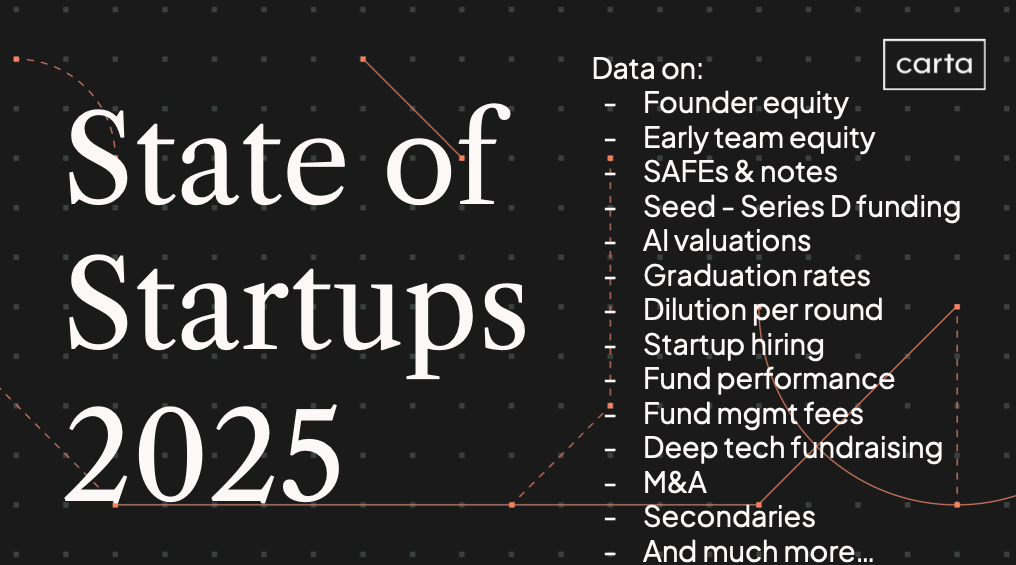
Carta's State of Startups 2025 report, analyzing data from over 60,000 startups and 3,000 venture funds, reveals a market operating at two distinct speeds. Capital flows freely to what the company terms "the most legible founders," while the rest of the ecosystem struggles for attention and resources.


AI startups captured 44% of all US startup capital in 2025, commanding record valuations and pulling away from the broader market. The top decile of seed rounds shows dramatic separation from median valuations, with premium rounds reaching $80 million compared to the $20 million median. Geographic concentration remains stark: San Francisco and New York together account for two-thirds of top decile seed rounds.
The report documents a liquidity crunch driven by scarce IPO opportunities, pushing the market toward secondary transactions as an alternative exit path. Initial equity grants have shrunk 50% since late 2022, while team sizes contracted significantly—the average seed-stage company now employs 6.2 equity-holding team members, down from 10.3 at the 2021 peak. The first half of 2025 recorded the lowest hiring rate since before 2019.
Solo founders comprised 35% of all startups incorporated in 2024, more than double the 17% rate from 2015. However, among companies that successfully raised venture capital, only 17% had solo founders, revealing a disconnect between incorporation trends and funding reality.
For founders in the Uristocrat network - building ventures at the intersection of culture, creativity, and commerce = this split market demands strategic positioning beyond conventional startup metrics. The data suggests that cultural legibility, not just technical execution, determines access to premium capital.
Actionable steps:
- Build narrative infrastructure early, treating your story as product development rather than marketing afterthought.
- Leverage cultural credentials and community ties as institutional signals that translate across traditional venture barriers.
- Consider geographic flexibility strategically—proximity to capital hubs matters, but remote cultural authenticity can command attention when packaged correctly.
- Finally, if bootstrapping or raising outside top-tier channels, optimize for capital efficiency from day one rather than scaling playbooks designed for abundant funding environments that may not materialize.




Comments