
Recent From Uristocrat
This week we've been deep in infrastructure plays — from semiconductor chip strategy to energy costs reshaping the AI buildout. If you missed our analysis on the four-layer infrastructure stack powering the AI boom, read through it here. We also broke down how Paper.design is rebuilding the design-to-code pipeline with real web primitives instead of proprietary formats — a thesis that extends to how AI agents will interact with design systems this decade. For cultural context, the Hawks' Magic City collaboration on March 16 remains unmatched as an example of a franchise genuinely anchoring itself to the city's identity.
Sneakers
Today is your last wide release opportunity for the Fragment x Union x Air Jordan 1 High OG in black and varsity red via SNKRS at 10 a.m. ET. This collab has been heating the secondary market since All-Star Weekend — currently averaging $386 on StockX across nearly 3,000 sales. The Frankenstein'd collar treatment (fragment's thunderbolt logo on the lateral heel, Union's split colorway treatment on the collar) has cemented itself as one of the most desired drops of the year. Expect it to sell out immediately.
Over the weekend, watch for the Air Jordan 5 "Wolf Grey" on February 28 at $220 retail — a classic silhouette returning in that sought-after grey palette. The broader release calendar through March continues to favor archive retros and designer collabs over new silhouettes, a signal that nostalgia-driven demand remains the strongest lever in sneaker marketing right now.
Sports
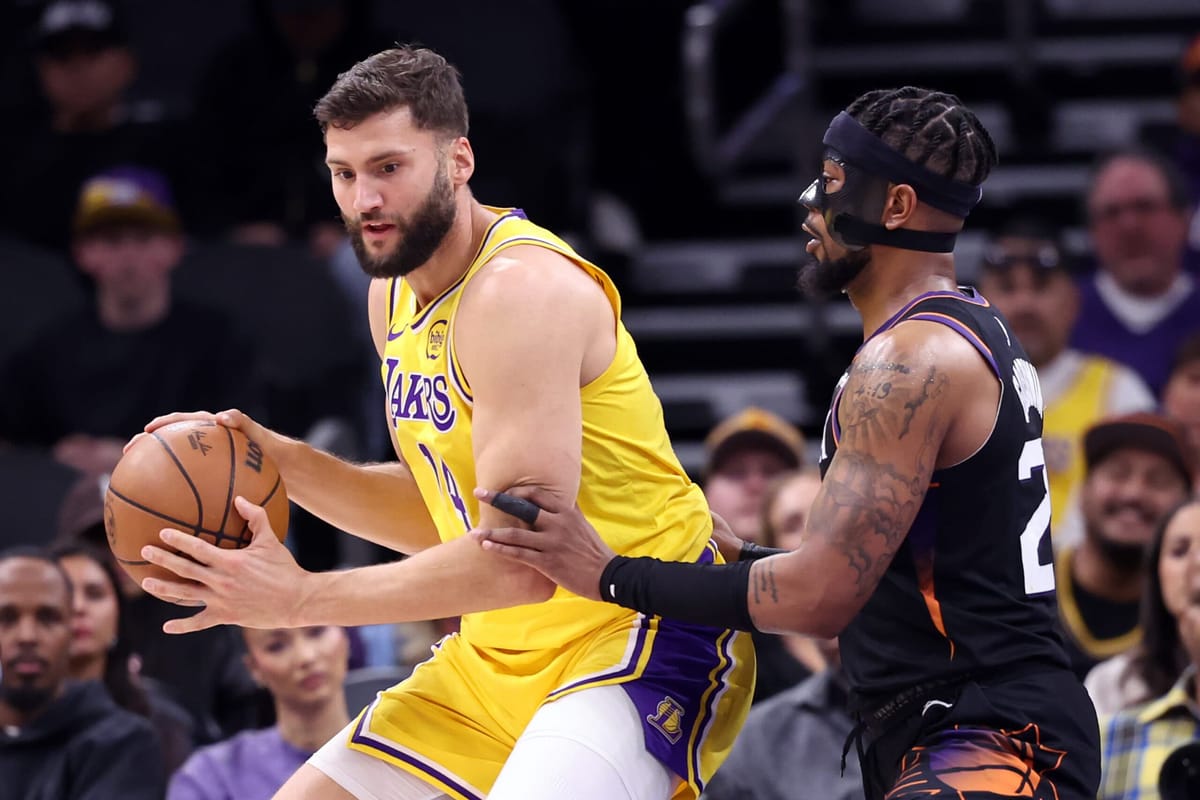
The Phoenix Suns pulled off a gutsy win last night, with Royce O'Neale nailing a 3-pointer with 0.9 seconds remaining to beat the Los Angeles Lakers 113-110. Grayson Allen led the Suns with 28 points — a short-handed performance that underscores Phoenix's depth. The Lakers blew a 12-point late lead, a narrative beat that will echo through March as playoff positioning tightens. Denver's blowout over Portland (157-103) earlier this week set a season scoring record and reinforced that when the Nuggets' roster is healthy, they remain the most dangerous team in the West on any given night.
Culture
Scrubs returns tonight on ABC as a rebooted comedy series — a moment of genuine cultural recalibration. The hospital sitcom defined an era's humor about work, friendship, and the absurdity of institutional life. Returning to that canvas in 2026 signals that networks are no longer fighting streaming but rather competing for event-level cultural moments. CBS counters with Survivor Season 50, Jeff Probst's continued stewardship a reminder that unscripted television has adapted better than scripted to the fragmented viewing landscape. Netflix drops Bridgerton Season 4 Part 2 on February 26, continuing the Regency romance formula that has proven ageless across three continents and four seasons.
Technology
Meta has quietly moved to diversify its compute strategy, signing a multi-year agreement to rent Google's in-house AI chips (TPUs) for training and inference. This is a meaningful shift in how hyperscalers compete. For years, Google's TPU advantage stayed contained within Google's ecosystem. If Meta becomes a major tenant, it signals two things: first, that Nvidia-class compute demand is still tight enough that even the biggest buyers are hedging; second, that chip strategy is no longer just about silicon — it's about supply assurance, software tooling, and vendor negotiating leverage. For startups building training efficiency tools or multi-cloud inference, this deal raises the pressure to support heterogeneous accelerators beyond Nvidia.
Google's Android 17 Beta 2 expands the "bubbles" API beyond messaging, introducing floating, resizable app windows across the system. On foldables and tablets, users can drag an app into a corner to launch a floating window — a productivity upgrade that speaks to how Android is positioning itself for modular, multi-window computing. The broader phone industry is preparing for unusually ambitious hardware experiments at Mobile World Congress, including rotating camera systems and modular add-ons. Global smartphone growth has been sluggish and upgrade cycles lengthened, so manufacturers are hunting for tangible hardware differentiation — the kind you can see and feel. For startups building accessory ecosystems or device integrations, modularity could revive niche product categories that died in the slab-phone era.
Amazon is expanding its in-house AI chip program with Trainium (built by Annapurna Labs in Austin), while the White House is hosting a "Rate Payer Protection Pledge" on March 4 with leading data center and AI companies. The pledge's core idea is direct: tech companies expanding compute should shoulder more of the incremental power costs, rather than passing them to households through utility rate structures. This matters because the AI infrastructure buildout is entering a phase where energy procurement, grid interconnection queues, and power-price volatility become gating factors alongside chips and talent. NVIDIA's record quarterly revenue of $68.1B reinforces that demand remains intense — the company's results are effectively a readout on the health of the AI buildout cycle.
Shop The Moment
Sneaker collaborations, infrastructure plays, and cultural moments that matter: explore The Uristocrat Store for curated selections that bridge the gap between what's happening and what's worth owning.
Comments